


Supervisory priorities 2027-29
1 Introduction
The supervisory priorities for 2027-29 reflect ECB Banking Supervision’s medium-term strategy for the next three years. These priorities are set by the Supervisory Board on the basis of a comprehensive risk assessment. They are reviewed annually to reflect changes to the risk landscape, progress against past objectives and the outcomes of supervisory activities such as the Supervisory Review and Evaluation Process (SREP).[1] This annual review ensures a forward-looking, risk-based approach that facilitates efficient resource allocation. It also makes supervisory actions more transparent for banks and provides the flexibility to adjust the priorities to a changing risk environment.
The European banking sector has shown strong resilience over the past year, supported by robust capital and liquidity buffers, stable asset quality and solid profitability, despite significant challenges. Geopolitical events, including military conflicts and rising trade barriers, have posed major macro-financial headwinds to euro area economic growth, fuelling inflationary pressures and intensifying uncertainty. Strong fundamentals have allowed banks to navigate these external shocks while effectively supporting the economy. The results of the 2026 thematic stress test provide further evidence of their ability to prepare for and tackle adverse scenarios in a highly uncertain environment. Indeed, most banks meaningfully translated their geopolitical scenarios into risk drivers and showed a sound understanding of the transmission channels. Still, some banks need to strengthen the granularity and scenario sensitivity in order to consistently translate their scenarios into solvency and liquidity metrics, develop prudent balance sheet projections and draw up realistic mitigating actions.[2]
Nonetheless, European banks face growing challenges from an increasingly complex and fast-changing environment marked by elevated uncertainties and persistent tail risks, which calls for prudent risk-taking and sound risk management. Even though the sector has proven resilient so far, it may take some time for the impact of geopolitical shocks, together with more structural trends such as climate and nature-related risks and technological advances, to materialise on banks’ balance sheets. This depends on the specific nature of the shocks, as well as the speed and magnitude of their transmission to the economy, financial markets or individual banks themselves. At the same time, banks need to consider that further limited fiscal space may constrain the capacity of public authorities to buffer future shocks. In this context, strong governance, prudent risk management and adequate capital and liquidity buffers are essential for ensuring that banks can absorb future shocks while continuing to provide financing to households and businesses. Operational resilience is also a critical focus as banks adapt to rapid digital transformation and emerging technologies, such as advanced artificial intelligence (AI), which introduce new vulnerabilities, including dependencies on third-party providers and heightened cyber risks. This means that banks must remain agile in addressing these challenges while ensuring the continuity of their critical services and compliance with regulatory requirements such as the EU’s Digital Operational Resilience Act (DORA).
The supervisory priorities for 2027-29 are broadly similar to last year. As in previous years, they balance continuity with the need to address emerging risks and new vulnerabilities. In particular, the priorities reflect the need for banks to strengthen their financial resilience to geopolitical risks and macro-financial shocks (Priority 1), as well as to strengthen their operational resilience and ICT capabilities in response to emerging threats (Priority 2). Each priority targets specific vulnerabilities, for which dedicated strategic objectives have been set and tailored work programmes developed with a view to fostering a resilient European banking sector capable of navigating an increasingly complex risk landscape.[3]
Figure 1
Supervisory priorities for 2027-29
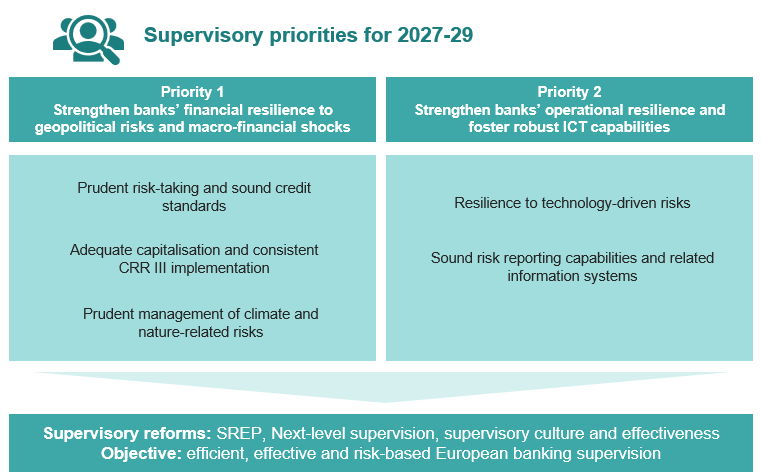
Source: ECB.
The supervisory priorities address the most relevant vulnerabilities of banks and promote consistency and effectiveness in the planning of the Joint Supervisory Teams (JSTs) for cross-cutting risks. They provide the basis for supervisory planning, which reflects both system-wide priorities and more idiosyncratic, institution-specific areas of concern, and support supervisors in allocating resources in line with predefined risk tolerance levels. In order to foster effectiveness and synergies at the European banking sector level, the supervisory priorities are developed in close collaboration with the national competent authorities and other European authorities, in particular the European Banking Authority and the Single Resolution Board. For national supervisors overseeing less significant institutions, the system-wide supervisory priorities serve as a useful reference for setting proportionate oversight strategies. Clear communication of these priorities is critical to fostering transparency and consistency in European banking supervision and clarifying expectations for banks.
A system-wide approach to setting priorities is key to the ongoing supervisory reforms and ensuring that European banking supervision remains efficient, effective and responsive to emerging risks in an evolving financial landscape.[4] These reforms – which include an overhaul of the SREP, the “Next-level supervision” initiative and the supervisory culture and effectiveness assessment – are designed to reduce complexity and strengthen risk-based supervision. By steering the ECB’s strategic planning, the supervisory priorities contribute directly to the reforms’ objectives, as they focus on the most relevant risks, fostering timely and effective management of vulnerabilities across the banking sector. When translating these priorities into concrete activities, such as on-site inspections (OSIs) and horizontal reviews, the supervisors use a risk tolerance framework that combines these overarching priorities with institution-specific assessments. This balance between system-wide and institution-specific risks and priorities makes it possible to streamline supervisory actions and limit implications for individual banks at the same time as reinforcing the overall resilience and stability of the European banking sector.
2 Risk assessment and supervisory priorities for 2027-29
2.1 Geopolitical and macro-financial environment
Materialising geopolitical risks, rising trade barriers and increasing global fragmentation continue to challenge the macroeconomic outlook for the euro area and its banking sector. The conflict in the Middle East has intensified global instability, triggering a spike in risk perceptions, sharp financial market repricing and heightened economic policy uncertainty in Europe. This is compounding ongoing trade tensions and the persisting effects of Russia’s war against Ukraine. The conflict in the Middle East has caused significant disruptions in oil and gas markets, resulting in the largest supply shock in oil market history.[5] While the immediate impact on the European banking sector has so far been limited, a further escalation of the situation in the Middle East and delayed second-round effects, through, for instance, equity and bond markets, higher inflation and slower economic growth, could weigh on banks’ asset quality and resilience in the future.
The euro area economy has proved resilient to the Middle East energy shock, but uncertainty persists, with headline inflation expected to remain above the ECB’s 2% target in the short term.[6] Despite the resilience shown in the first half of the year, the short-term economic outlook for the euro area remains highly uncertain amid the ongoing conflict in the Middle East and continued volatility in energy markets. Over the medium term, domestic demand is expected to continue to be the main driver of economic growth in the euro area, supported by a recovery in real incomes, a resilient labour market and rising government spending on infrastructure and defence, complemented by investments related to AI.[7] However, elevated energy prices and tighter financing conditions have increased fiscal vulnerabilities, limiting governments’ capacity to shield households and firms from future shocks. [8] These persisting fiscal challenges, coupled with heightened uncertainty, may create negative feedback loops between sovereigns, financial markets and the real economy.
Downside risks to euro area economic growth remain heightened, due primarily to the elevated geopolitical tensions.[9] Any further disruption of energy supplies could amplify inflationary pressures, erode real incomes and curtail investment. A deterioration in global financial markets could tighten credit supply and weaken demand, while resurging trade frictions could exacerbate supply chain disruptions, dampen exports and curb consumption and investment. Persistent geopolitical uncertainties stemming from Russia’s war against Ukraine and other ongoing conflicts, rising defence expenditure and constrained fiscal space are hindering governments’ ability to address structural challenges related to digitalisation, low productivity growth, population ageing and climate change.[10] The insurance protection gap,[11] which remains substantial, coupled with limited adaptation incentives for companies, is increasingly shifting losses from climate-related and natural catastrophes onto public balance sheets, further straining fiscal resources and reinforcing negative feedback loops.[12] The interaction of vulnerabilities in different markets (e.g. high-yield debt, leveraged finance, AI-related stocks), historically high sovereign debt levels and tightening financing conditions could create systemic instability, at a time when structural fiscal imbalances could limit the capacity for potential public sector support in a systemic crisis.
Prolonged or even deepening geopolitical tensions, fiscal imbalances and emerging risks from disruptive technologies such as AI could test financial market sentiment.[13] The conflict in the Middle East triggered a sharp repricing in financial markets – and especially equity – in March 2026, however, markets rebounded quickly. Meanwhile, equity valuations have moderated but continue to rely on ambitious earnings expectations, particularly in the technology sector.[14] Market concentration and interconnections among a small number of large tech firms have increased, rendering global equity markets more sensitive to shocks originating from individual firms. Financial markets remain vulnerable to sharp adjustments driven by strong earnings expectations for equities, concentrated exposures and AI-related disruptions, compounded by vulnerabilities in non-bank financial institutions (NBFIs). While interconnections between euro area banks and NBFIs continue to grow, the underlying risks are considered mostly relevant to only a few banks. However, these interconnected exposures could amplify vulnerabilities at the system level, particularly during episodes of market stress, leading to spillovers across financial institutions and markets.
2.2 Priority 1: Strengthen banks’ financial resilience to geopolitical risks and macro-financial shocks
External headwinds from the geopolitical and macro-financial environment continue to challenge the financial resilience of the European banking sector, requiring targeted supervisory focus. Since the weaker euro area macroeconomic outlook might take time to affect banks’ asset quality, it is essential for banks to maintain sound credit underwriting standards and robust credit risk management practices. Moreover, banks’ growing interconnections with the NBFI sector warrant close supervisory scrutiny, particularly for banks with significant exposures to riskier counterparts, due to higher leverage, for instance.[15] Furthermore, it remains crucial that banks effectively implement the CRR III/CRD VI package to align their capital requirements with actual risk-taking. Therefore, supervisors will continue to focus on banks’ accurate calculation of risk-weighted assets, especially under the more granular and risk-sensitive standardised approaches. Moreover, climate and nature-related exposures remain a key vulnerability, as the risks continue to increase and banks continue to face challenges in integrating these risks into their risk management frameworks and prudential transition planning.
Geopolitical risks, which have grown over the past year, remain a focus of the ECB’s supervisory priorities. As a cross-cutting risk driver, geopolitical risks affect both the financial and operational resilience of banks, as they propagate through multiple channels simultaneously,[16] making them a key consideration in both priorities-related and regular supervisory activities.
Prudent risk-taking and sound credit standards
Strategic objective: To foster prudent risk-taking, supervised entities should maintain sound credit standards and risk-based pricing, adapt to macro-financial changes and institution-specific circumstances, and effectively manage risks from material exposures to higher-risk NBFIs.
Over the past year, the European banking sector has reported stable asset quality despite external challenges and country-level differences. Non-performing loan (NPL) ratios have remained low, supported by strong private sector fundamentals and a stable labour market. While banks in some countries experienced a material deterioration in asset quality, particularly in the small and medium-sized enterprise segment, most asset classes showed an improvement. Consumer credit was an exception, with NPL and Stage 2 ratios rising significantly, while lending standards continued to tighten in that segment. At the same time, mortgage portfolios remained resilient, with NPL ratios at low levels, supported by rising housing prices. While conditions in commercial real estate markets have shown signs of stabilisation, significant uncertainty and downside risks persist, particularly in relation to refinancing needs, project development lending, property valuations and the delayed materialisation of credit risks. Looking ahead, the current geopolitical environment – marked by a significant and lasting energy shock, increased international competition and lingering tariff uncertainties – poses risks to corporate balance sheets, particularly in energy-intensive sectors such as manufacturing, and including the automotive and chemicals sectors. Other sectors, such as transport and agriculture, may also face challenges from supply chain disruptions, rising input costs, but also extreme weather events. These developments underline the need for sound credit risk management, an area designated for improvement in the 2026 SREP outcomes.[17] While the impact of recent shocks has not yet materialised on bank balance sheets, the cost of risk has already increased for most banks, albeit remaining close to its long-run average, and additional shocks could make it necessary for them to increase their provisions going forward.
Given this challenging outlook, it is essential that banks apply prudent credit underwriting standards and maintain robust risk management practices. In 2026 ECB Banking Supervision conducted a thematic review to assess credit underwriting standards across supervised entities, with a particular focus on new lending. As a result, banks could apply the findings from this review to help them benchmark their practices against peers, strengthen their risk appetite frameworks and better align with the supervisory expectations. Going forward, follow-up supervisory initiatives, consisting of targeted off-site and on-site reviews, will build on the outcome of the thematic review to engage with any outlier banks. The off-site activities will mainly target banks’ assessments of borrowers’ creditworthiness in the residential real estate and corporate segments.
An area of growing concern for supervisors is banks’ exposures to more vulnerable and riskier NBFIs, even though at this stage they should only be considered material for a few banks. These exposures primarily stem from capital market services, such as securities financing transactions and derivative transactions, which give rise to counterparty credit risk. This risk is exacerbated during periods of marked volatility and could spill over to the broader financial market, should it materialise. Moreover, banks may be exposed to NBFIs through funding channels, credit lines or direct lending, including private markets. The volume of transactions conducted by banks with NBFIs has increased over the past year and is largely concentrated within a few institutions, while counterparty credit risk remains largely contained at the sectoral level. Earlier in 2026, concerns about asset quality deterioration triggered a surge in redemption requests from semi-liquid NBFI vehicles, particularly in the private credit space, but no widespread deterioration has been observed and banks’ direct exposures remain contained.[18]
Supervisory scrutiny of bank-NBFI interlinkages has intensified in recent years, with several reviews revealing shortcomings in banks’ management of counterparty credit risk, prime brokerage and private markets activities. An exploratory scenario exercise on counterparty credit risk[19] focusing on a few selected institutions revealed a concentration of exposures to counterparties below investment grade in hedge fund, private equity and family offices, whereas collateralisation levels for NBFI counterparties were comparatively high. This exercise also showed that the majority of participating banks did not have NBFI-specific stress-testing frameworks or risk limits in place. A further analysis of banks’ exposures to private equity and credit funds revealed weaknesses in risk management for these segments.[20] As a result, supervisors will conduct a targeted follow-up on banks’ efforts to apply the recommendations made regarding their risk management frameworks for fund financing.
Going forward, supervisors will continue closely monitoring these risk developments and banks’ compliance with the supervisory expectations for private market-related activities. A new OSI campaign will focus on fund financing, asset-based lending and shadow banking exposures, particularly those linked to private equity, private credit and funds investing in tangible assets. Supervisory efforts will concentrate on institutions with significant exposures to riskier counterparties rather than making it a system-wide priority.
Supervisory activities planned for these priorities
- Targeted reviews of banks’ creditworthiness assessments, focusing on the residential real estate and corporate segments
- OSI campaign on credit underwriting standards and targeted OSIs on loan pricing
- Targeted follow-up on banks’ adherence to risk management framework recommendations for fund financing
- OSI campaign on fund financing, asset-based lending and NBFI exposures
Adequate capitalisation and consistent CRR III implementation
Strategic objective: Supervised entities should develop and maintain sound capital planning, reflecting potential impacts from adverse macro-financial and geopolitical shocks, and ensure appropriate implementation of the new CRR III requirements.
While adequate capital headroom supports banks’ resilience to adverse shocks, forward-looking risk management and sound capital planning remain crucial. After peaking in 2025 on the back of strong profitability, aggregate capital ratios for the European banking sector remained largely the same in 2026, resulting in robust buffers at system level. However, the heightened likelihood of tail risk events in the current uncertain environment underlines the need for prudent, forward-looking planning. The 2026 geopolitical risk reverse stress test revealed that banks had a sound overall understanding of the transmission channels affecting their solvency, liquidity and sources of income. That said, many stress-testing frameworks failed to accurately capture solvency-liquidity interactions. Furthermore, deficiencies were revealed in the translation of scenarios into solvency metrics, the feasibility of mitigating actions and assumptions regarding expanding balance sheets during systemic crises.[21] The 2026 SREP results also flagged persistent weaknesses in capital planning frameworks and projection accuracy.[22]
Going forward, supervisors will continue to assess banks’ internal capital adequacy assessment processes (ICAAP), focusing on capital projections and adverse scenario management. The 2027 EU-wide stress test will further evaluate banks’ resilience, incorporating climate-related transition and physical risks alongside macro-financial shocks for the first time.[23]
The CRR III framework aims to enhance banks’ ability to absorb economic shocks, although implementing this framework accurately and consistently remains challenging. After identifying those banks requiring closer scrutiny, targeted horizontal and on-site supervisory activities were launched in 2026 to benchmark banks’ practices and assess the accurate and consistent implementation of the standardised approaches used to calculate risk-weighted assets in credit risk and operational risk. These activities will continue into 2027 and be extended to gradually increase bank coverage.
As part of the supervisory reforms, ECB Banking Supervision introduced a fast-track procedure[24] in January 2026 to streamline and digitalise the assessment for eligible simple and standardised synthetic securitisations. With approximately 30% of all synthetic transactions meeting eligibility criteria, simplification is already taking place. The data collected through the digitalised fast-track process are used not only to assess the individual transactions but also bank-specific and system-level vulnerabilities. In parallel, a project is under way to digitalise securitisation notifications outside the fast-track process. Overall, it remains critical for supervisors to assess banks’ overall strategy, risk management and capital frameworks to ensure that risks[25] posed by securitisations are adequately identified, measured, monitored, reported and managed. Against this backdrop, in 2027 the ECB will conduct a targeted review of selected banks to examine their significant risk transfer (SRT) strategies, risk appetite frameworks, end-to-end transaction management practices and SRT integration into capital plans and ICAAP scenarios. This horizontal review will be complemented by targeted OSIs on synthetic SRT securitisation.
Supervisory activities planned for these priorities
- Targeted review of how credit risk-weighted assets are calculated under the standardised approach, complemented by an OSI campaign
- Targeted review of the business indicator component supporting the calculation of capital requirements for operational risk
- Targeted review of SRT strategy and risk management, complemented by targeted OSIs on synthetic SRT securitisation
Prudent management of climate and nature-related risks
Strategic objective: Supervised entities should effectively assess and manage short, medium and long-term risks stemming from the various climate and nature crises and remedy persistent shortcomings in their related risk management frameworks.
With global CO2 emissions from fossil fuels reaching a record high in 2025 and temperatures continuing to rise, climate and nature-related risks continue to pose significant challenges for the euro area economy and banks alike. Extreme weather events are increasing in frequency and severity,[26] with growing pressure on economic growth.[27] These are amplified by the degradation of biophysical and hydrological assets such as forests, riverbeds and groundwater reservoirs. At the same time, risks of a disorderly transition remain elevated, as policy uncertainty and frictions affect investment decisions and raise transition costs. The conflict in the Middle East and recent disruptions in oil and gas supplies have temporarily boosted fossil fuel use, with some countries, including in the EU, turning back to coal. Although energy-security concerns, economic incentives and initiatives such as AccelerateEU and Electrification Action Plan support the long-term shift to clean energy, the transition remains off track. Most Member States are now considered likely to miss their 2030 climate targets and the collective emissions trajectories of listed companies imply a global warming of 3°C.[28]
After the ECB’s five-year climate and nature risk programme came to an end in 2025, supervisors continued to follow up on the remaining material shortcomings. Throughout 2025, supervisors closely monitored the remediation of those shortcomings, also through targeted OSIs. While supervised entities have made significant progress overall, approaches to climate and nature-related risk management remain uneven. Gaps in the comprehensive coverage of all material portfolios, exposures and risk categories continue to raise concerns. Future impacts remain highly uncertain and are likely to be underestimated, as important amplifiers, transmission channels and mitigation mechanisms are only partially reflected in current frameworks.[29] Supervisors continued to follow up on the remaining vulnerabilities as part of their regular activities. New prudential mandates in CRR III/CRD VI, alongside regulatory expectations outlined in the EBA’s Guidelines on the management of ESG risks, have been introduced in supervisory practice in a gradual and targeted way, addressing areas previously not covered in the ECB’s Guide on climate-related and environmental risks. To further help banks close gaps in their risk management frameworks and address vulnerabilities in the evolving risk environment, ECB Banking Supervision updated its compendium of good practices for climate and nature risk management and report on good practices for climate and nature-related risk stress testing in May 2026.
Looking ahead, supervisors will focus on banks’ practices to enhance their prudential transition planning capabilities and address persistent challenges relating to climate and nature-related risk management, with an increased focus on physical risk. Informal structured dialogues with a sample of banks on prudential transition planning began in 2025 and have continued into 2026, including as part of OSIs. The aim is to foster a shared understanding of supervisory expectations and allow supervisors to take stock of banks’ transition planning approaches and identify areas for improvement. As a next step, the ECB will conduct a thematic review in 2027 to assess banks’ prudential transition planning capabilities. Supervisors will also continue their analysis of banks’ ability to address persistent physical risk challenges in a selected group of banks. The focus will be on assessing banks’ preparations for, and capabilities to identify, measure and respond to, physical risk. In addition to the medium-term goal of fully integrating climate and nature-related risks into all classic banking risk categories during regular OSIs, in 2028 supervisors intend to carry out targeted OSIs of water-related risks on top of following up on the findings from the prudential transition planning thematic review.
Supervisory activities planned for these priorities
- Thematic review of banks’ prudential transition planning in line with the CRR III/CRD VI package
- Deep dive into banks’ capabilities to address ongoing challenges, including climate and nature-related physical risk
- Targeted OSIs focusing on (1) follow-ups to the prudential transition planning thematic review, (2) water-related risks, and (3) further integration of climate and nature-related risks into credit risk and into ICAAP OSIs
2.3 Priority 2: Strengthen banks’ operational resilience and foster robust ICT capabilities
Rapid technological advances and growing cyber threats, compounded by the current geopolitical environment, underline the need for the European banking sector to develop, maintain and, where needed, enhance its capabilities in information and communications technology (ICT) and operational resilience. Supervisory activities will focus on banks’ remediation efforts to address vulnerabilities in their ICT security and third-party risk management frameworks, particularly those flagged in prior reviews. As the emergence of advanced AI frontier models has further transformed the risk landscape, enabling more sophisticated cyberattacks and technology-driven fraud, the timely and effective remediation of previously identified shortcomings has become even more critical. The fast-paced development and adoption of AI models, alongside their interconnections with other technology-driven risks, have increased the need to strengthen the supervisory focus on banks’ AI strategies, risk management and governance structures. As a result, the scope of the medium to long-term priority strategy on banks’ digital and, in particular, AI-related strategies, governance and risk management, which was introduced in last year’s supervisory priorities, has been integrated into the regular supervisory work on technology-driven risks. It is equally important that banks address governance weaknesses, particularly in risk data aggregation and risk reporting (RDARR), as this remains a key area for improvement. Solid RDARR foundations are essential for effective risk oversight and decision-making in an increasingly complex environment. This dual focus should enable banks to mitigate evolving risks, while maximising the transformative potential of AI-driven innovation.
Resilience to technology-driven risks
Strategic objective: Supervised entities should strengthen their operational resilience by enhancing their ICT security and third-party risk management frameworks, while addressing challenges posed by emerging technologies, such as AI and quantum computing. Supervised entities should also have in place robust digital strategies, governance frameworks and risk controls to balance innovation with evolving threats so as to foster security and sustained competitiveness.
Increasing cyber threats and rapid technological advances are very challenging for banks operating in an increasingly complex geopolitical environment. Like many critical financial market infrastructures, banks face more frequent, targeted and sophisticated cyberattacks,[30] compounded by state-sponsored malicious activity and heightened supply chain vulnerabilities. Their reliance on a few critical service providers, particularly non-EU cloud providers, exacerbate these risks amid increasing concentration, low substitutability, exit and migration capabilities, and wider supply chain dependencies. Frontier AI models that are capable of autonomously identifying vulnerabilities and executing advanced cyberattacks with unprecedented speed and precision further amplify these operational and financial stability risks.[31] Alongside cyber and ICT-related risks, fraud risk has grown sharply over the past few years due to technology-related vulnerabilities and financial crime,[32] though related bank losses remain very limited.
Banks now need to step up their efforts to develop, maintain and, where needed, enhance their operational risk management frameworks. Supervisory reviews and the 2026 SREP results reveal persistent material deficiencies in operational risk management, with ICT risk consistently scoring poorly.[33] The main deficiencies relate to cybersecurity practices, basic cyber hygiene and third-party risk management, demonstrating the need for banks to strengthen their practices in these areas.[34] A Dear CEO letter on AI-enabled cybersecurity threats from ECB Banking Supervision, issued alongside the ESRB warning on systemic cyber risks stemming from frontier artificial intelligence models, stressed the critical importance of addressing unresolved supervisory findings, emerging AI-enabled threats and compliance with DORA.
In the past few years, ECB Banking Supervision has deepened its understanding of banks’ digital strategies, AI use cases and risk management practices through ongoing interactions and thematic workshops. While banks are making strides in aligning AI initiatives with broader digital strategies, improving their governance arrangements and preparing for the EU AI Act, further work is needed in areas such as transparency, explainability and data governance. These deficiencies prove the need for continued focus on RDARR to ensure consistent and reliable outcomes. In 2026 a horizontal initiative on generative AI applications explored both the opportunities and the associated risks of AI and assessed banks’ preparedness for managing such challenges.
Going forward, the supervisory priorities will focus on strengthening banks’ ICT risk management and operational resilience, as well as on fostering the banking sector’s efforts to adapt to emerging technologies. Much of the forthcoming supervisory engagement with banks will be dedicated to the remediation of outstanding ICT risk findings and measures identified in previous years as part of the broader “refocusing exercise”.[35] This exercise involves a structured review of open findings and measures, which considers several factors, including their severity, age, prudential relevance and remediation status, and the likelihood that further supervisory intervention may be required. Alongside the roll-out of this system-wide remediation initiative, complementary supervisory activities will focus on ICT security risk, including the continuation of the OSI campaign on cybersecurity management and threat-led penetration testing in line with DORA requirements.
Furthermore, follow-up initiatives will evaluate banks’ readiness for post-quantum cryptography migration, emphasising the need for timely preparation, as well as the action plans devised by banks in response to the Dear CEO letter on AI-enabled cybersecurity threats with a view to identifying trends, challenges and areas for improvement. In the area of third-party risk management, supervisors will extend the related OSI campaign and conduct a targeted review of cloud service provider dependencies. The objective here is to uncover risks associated with banks’ reliance on external providers for critical functions and assess whether banks have in place adequate measures to respond to and recover from a potential disruption of service. An extension of the 2026 targeted review of ICT change management is also planned. Moreover, ECB Banking Supervision will inform relevant banks about the risks identified by the Lead Overseer in the recommendations sent to critical third-party providers of ICT services so that banks address such risks within their own third-party risk management frameworks as well.[36]
ECB Banking Supervision is stepping up efforts to strengthen its understanding of AI-related risks across the industry and the public sector. Beyond the ongoing cooperation with AI oversight authorities, this may entail structured engagement among banks and supervisors to foster exchanges on emerging issues such as the prudential materiality of AI-related risks, model accuracy and explainability, the quality of input data and quantifying the benefits of AI use cases. Additionally, pilot off-site and on-site reviews will examine how the governance and risk management frameworks of the limited number of banks under review support AI deployment, assessing whether the underlying risks are adequately controlled and aligned with banks’ strategic objectives and risk appetite.
Supervisory activities planned for these priorities
- System-wide strategy on remediation of material ICT risks findings and measures identified in previous activities
- Two OSI campaigns on cybersecurity management and third-party risk management
- Threat-led penetration testing, in line with DORA requirements
- Targeted review of ICT change management
- Targeted review of banks’ cloud service provider dependencies
- Quantum computing readiness survey to assess banks’ readiness for their post-quantum cryptography migration
- Horizontal analysis of banks’ action plans on frontier AI models and targeted follow-ups
- Structured engagement with the industry focusing on AI use cases and related governance and risk management implications, complemented by pilot off-site and on-site missions
Sound risk reporting capabilities and related information systems
Strategic objective: To foster sound risk management and effective decision-making, supervised entities should strengthen their efforts to effectively and promptly remedy material weaknesses identified in their RDARR frameworks. They should also bring them into line with the supervisory expectations laid down in the ECB’s Guide on effective risk data aggregation and risk reporting and the Basel Committee on Banking Supervision’s principles for effective risk data aggregation and risk reporting (BCBS 239).
Technological advances and the uncertain geopolitical environment underline the critical importance of strong RDARR capabilities in banks. Timely and accurate reporting, which are essential for banks’ effective strategic steering and risk management – particularly in times of crisis − remain crucial in the current uncertain environment. At the same time, the rapid pace of technological innovation and the increasing adoption of AI are creating strong incentives for banks to prioritise high-quality data, enhanced automation and the modernisation of IT architectures. Not only does this position RDARR as an essential element of compliance, it also makes a strong business case for many institutions to support their innovation initiatives.
Supervised entities have made notable progress in tackling RDARR-related vulnerabilities, driven in part by increased supervisory attention. However, there is further need yet to reinforce the current remediation efforts. The supervisory monitoring of banks’ progress under the system-wide remediation strategy for RDARR indicates greater focus by supervised entities on addressing RDARR/BCBS 239 deficiencies.[37] Multi-year remediation programmes are being progressively implemented and are showing improved engagement from management bodies. At the same time, material deficiencies persist, including in IT and data architectures, data lineage, data quality controls, excessive reliance on manual processes and recurring supervisory reporting issues. Execution risks remain high, given the complexity and lengthy timelines of transformation programmes. These deficiencies are also reflected in persistently weak SREP scores in RDARR.[38]
Going forward, supervisors will continue to focus on ensuring effective remediation efforts. These efforts are expected to intensify over the coming year, with a large number of severe supervisory measures in RDARR due to be addressed by the end of 2026 and 2027. Supervisors will continue to closely monitor banks’ remediation progress as part of the system-wide RDARR strategy, focusing on the most material deficiencies, in line with the discussed and agreed deadlines. Some follow-up OSIs will also concentrate on assessing the effective remediation of more complex findings identified in past reviews. Where necessary, supervisors will make full use of the existing supervisory powers to encourage banks’ compliance going forward. Additionally, some targeted OSIs will be conducted at supervised entities where the assessment of RDARR capabilities needs to be updated or has not been performed so far.
Supervisory activities planned for these priorities
- Continuation of the remediation strategy on severe supervisory measures in RDARR
- Targeted OSIs focused on RDARR frameworks for banks requiring further assessment, along with targeted follow-up OSIs to address previously identified severe deficiencies
European Central Bank, 2026
Postal address 60640 Frankfurt am Main, Germany
Telephone +49 69 1344 0
Website www.bankingsupervision.europa.eu
All rights reserved. Reproduction for educational and non-commercial purposes is permitted provided that the source is acknowledged.
For specific terminology please refer to the SSM glossary (available in English only).
PDF ISBN 978-92-899-8046-3, ISSN 2599-8420, doi:10.2866/0560698, QB-01-26-243-EN-N
HTML ISBN 978-92-899-8045-6, ISSN 2599-8420, doi:10.2866/3302371, QB-01-26-243-EN-Q
See “Aggregated results of the 2026 SREP”, ECB, November 2026.
See “ECB publishes results of 2026 geopolitical risk reverse stress test”, press release, ECB, July 2026, and “Preparing for the unknown: lessons from the ECB’s reverse stress test on geopolitical risk”, The Supervision Blog, 11 September 2026.
For further information regarding the work programmes and definition of supervisory activities, please see “Box 1: The supervisory cycle – integrated planning of supervisory activities”, Supervisory priorities 2026-2028, ECB, 2025.
See “Streamlining supervision, safeguarding resilience: the ECB’s agenda for more effective, efficient and risk-based European banking supervision”, ECB, December 2025.
See “Oil Market Report”, International Energy Agency, March 2026.
See “ECB staff macroeconomic projections for the euro area, September 2026”, ECB.
ibid.
See “Financial Stability Review”, ECB, November 2026.
See “Monetary policy statement”, ECB, September 2026.
See “Financial Stability Review”, ECB, November 2026.
See Hielkema, P., “Insurance protection gaps in a changing climate”, European Insurance and Occupational Pensions Authority, April 2026.
See Grabbe, H., Keliauskaitė, U., Lappe, M.-S., Monasterolo, I., Tavoni, M. and Zachmann, G., “Planning for the rising fiscal costs of climate disasters”, Policy Brief, 13/2026, Bruegel, 16 June 2026.
See “Financial Stability Review”, ECB, November 2026.
ibid.
ibid.
See “Addressing the impact of geopolitical risk” on the ECB’s banking supervision website.
See “Aggregated results of the 2026 SREP”, ECB, November 2026.
See “Stress in global private credit markets and its implications for euro area financial stability”, Financial Stability Review, ECB, May 2026.
See “Counterparty credit risk exploratory scenario exercise – Final results”, ECB, August 2025.
See “Complex exposures to private equity and credit funds require sophisticated risk management”, Supervision Newsletter, ECB, 13 November 2024.
See “Geopolitical risk reverse stress test of euro area banks – 2026 SSM thematic stress test: final results”, ECB, July 2026.
See “Aggregated results of the 2026 SREP”, ECB, November 2026.
See “The EBA launches early consultation on simplified EU-wide stress test, with climate risk integration”, press release, European Banking Authority, 11 June 2026.
See “ECB launches fast-track assessments for capital and securitisation”, press release, ECB, 19 December 2025.
Significant risk transfers can make banks overly dependent on non-bank investors, exposing them to rollover risk, and interconnectedness with leveraged investors and weaker post-transfer monitoring may undermine genuine risk transfer.
See “WMO confirms 2025 was one of warmest years on record”, press release, The World Meteorological Organization, 14 January 2026, and the “European State of the Climate report”, European Commission, 2025.
See “Too hot to grow: The economic costs of extreme heat”, Allianz Research, 28 May 2026.
See “Transition Finance Tracker”, MSCI Institute, 2026.
See Trust, S. et al., “Planetary Solvency – finding our balance with nature”, Institute and Faculty of Actuaries, University of Exeter, January 2025.
See Elderson, F., “Strengthening operational resilience for the age of AI”, keynote speech at the Goldman Sachs European Financials Conference 2026, 3 June 2026.
See Aldasoro, I., Auer, R., Frost, J. and Perez-Cruz, F., “A Mythos moment? Frontier AI and cyber risk”, BIS Bulletin, No 129, Bank for International Settlements, July 2026.
See “Risk Assessment Report – June 2026”, European Banking Authority, June 2026.
See “Aggregated results of the 2026 SREP”, ECB, November 2026.
See “Aggregated results of the 2026 SREP”, ECB, November 2026.
See “Timely remediation for more resilient banks”, Supervision Newsletter, ECB, 12 August 2026.
In line with the EU’s Digital Operational Resilience Act Chapter V, Section II: Oversight Framework of critical ICT third-party service providers.
The strategy was approved by the Supervisory Board in December 2024 following the publication of the ECB’s Guide on effective risk data aggregation and risk reporting and formed part of the work programmes underlying the 2026-28 supervisory priorities.
See “Aggregated results of the 2026 SREP”, ECB, November 2026.