


On-site activities
In addition to the ongoing supervision of supervised entities conducted off-site by Joint Supervisory Teams (JSTs), the ECB also performs on-site supervisory activities on inspected entities’ premises. These include: on-site inspections (OSIs), covering risk controls and governance; internal model investigations (IMIs), which focus on the internal models used to calculate capital requirements; and asset quality reviews, aimed at determining capital levels. For the sake of simplicity, OSIs and IMIs are together referred to as “inspections” below.
On-site supervision is carried out in close collaboration with national competent authorities (NCAs), which provide around 85% of Single Supervisory Mechanism (SSM) inspectors. This model enables the ECB to leverage local expertise while applying a consistent supervisory approach across jurisdictions, which fosters a level playing field in the European banking market.
In addition to its on-site activities and complementing its ongoing supervision, the ECB is responsible for all aspects of the threat-led penetration testing (TLPT) conducted on significant institutions supervised by the ECB under the Digital Operational Resilience Act (DORA). The ECB carries out TLPT directly or in collaboration with the relevant teams at NCAs and national central banks.
The ECB is responsible for:
- leading and participating in on-site activities, mainly for larger European banks
- planning and executing inspections and asset quality reviews
- monitoring these inspections on an ongoing basis
- developing and maintaining inspection methodologies and supervisory tools
- training the inspectors
- ensuring consistent approaches and high standards across European banking supervision
- using insights from the field to identify the main risks to the banking sector
This work feeds into both the ongoing supervision by JSTs and the ECB’s horizontal activities, providing independent, in-depth assessments that complement and further strengthen the off-site supervisory work.
The ECB’s guide to on-site inspections and internal model investigations provides a detailed description of the general framework and processes applicable to inspections.
In line with the supervisory principles for the functioning of the SSM, inspections are:
- risk-based – focusing more on areas with higher risk or weaker controls, where on-going supervisory teams may need additional information, or where on-going supervisory techniques are insufficient
- in-depth – giving supervisors the opportunity to take a closer look at how the inspected entity works in practice
- proportional – matching the size, activities and risk profile of the inspected entity
- forward-looking – looking ahead to possible future negative impacts and potential risks, not just past or current figures
- action-oriented – leading to steps that help the inspected entity fix problems and/or, in the case of internal models, to approval or rejection of the model (change) applications
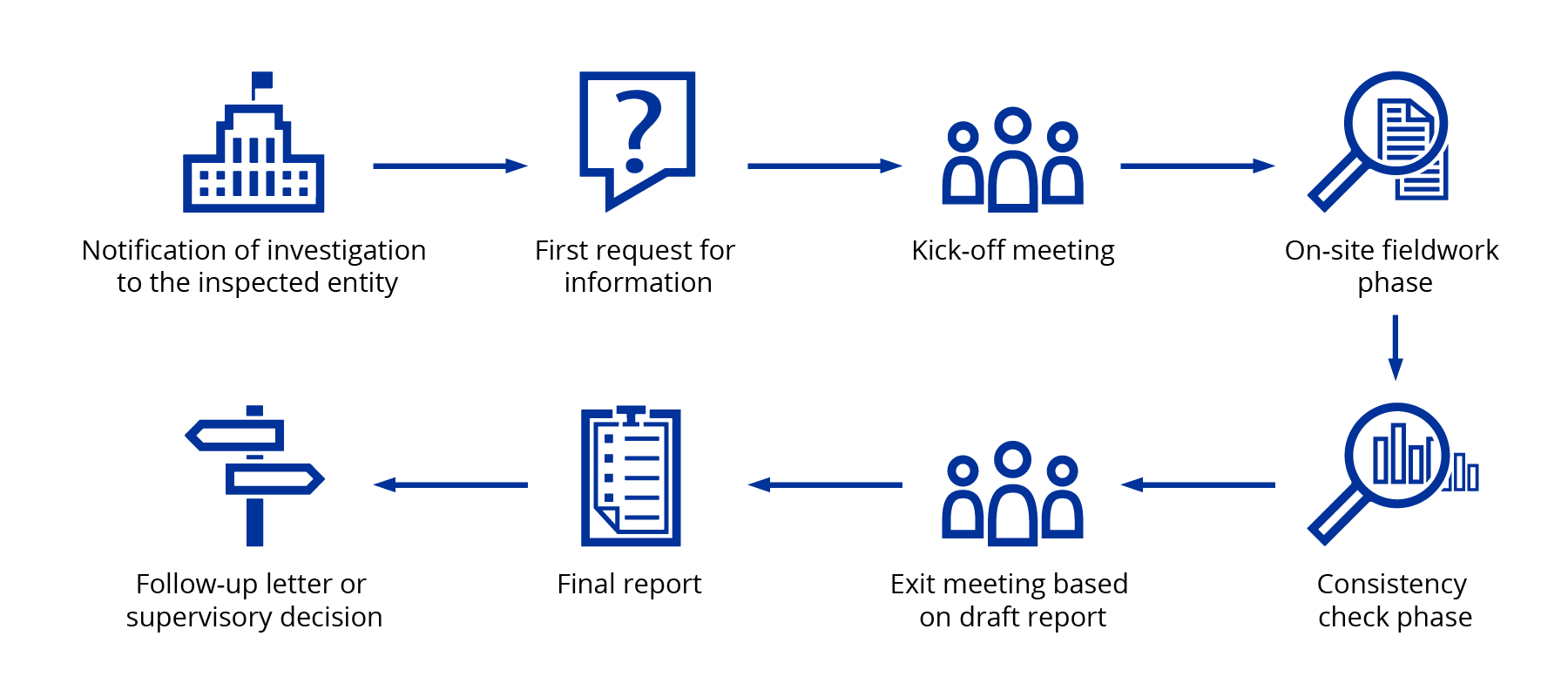
Notification of investigation to the inspected entity: The ECB notifies the inspected entity of the investigation in a letter to a designated nominee from the entity’s management board or supervisory board.
First request for information: Before the kick-off meeting, the Head of Mission (HoM) sends the inspected entity a first request for information and interviews. This request covers the information needed by the inspection team to prepare for the inspection and start the investigation phase.
Kick-off meeting: Chaired by the HoM, this is the first official meeting between the inspected entity and the inspection team.
On-site fieldwork phase: This phase consists of interviews and an examination of procedures, reports and files.
Consistency check phase: One or more SSM experts who were not part of the inspection team conduct a consistency review of the draft report to ensure that (i) the drafting of the report is aligned with internal guidance, and (ii) findings are well-grounded and consistent across inspected entities.
Exit meeting based on draft report: The draft report is discussed with the inspected entity in the final meeting of the on-site inspection.
Final report: The HoM finalises the draft report to be shared with the inspected entity, taking into account feedback from the consistency reviewer(s) and the entity.
Follow-up letter or supervisory decision: The JSTs are responsible for the follow-up phase of the inspection. The follow-up to findings and measures from on-site inspection reports is subject to the standard approach applied by the SSM. The ECB sends a final follow-up letter or supervisory decision to the inspected entity describing the recommended actions and, in the case of a decision, supervisory measures and required actions, including any deadlines.
- The Head of Mission (HoM) is appointed by the ECB from among ECB or NCA staff to lead the inspection. The HoM is the main contact person for the inspected entity on the topics reviewed during the inspection. The HoM manages the inspection team and organises the various steps of the inspection.
- The inspection team is appointed by the ECB and conducts all necessary inspections at the premises of the bank under the responsibility of the HoM. The team can be composed of inspectors from the ECB or the NCAs, members of the relevant Joint Supervisory Team or other persons authorised by the ECB.
- Joint Supervisory Teams (JSTs) work in close collaboration with the on-site inspection team, fostering effective interaction and information sharing to ensure an integrated and comprehensive approach to supervisory activities. The JSTs’ main contributions to on-site activities include preparing the field for – and eventually joining – the inspection team, maintaining close communication with the inspectors during the on-site phase and following up on the potential findings from the mission.
- The ECB’s Financial Risk Inspections and Non-Financial Risk Inspections Divisions oversee and participate in ongoing inspections, ensure consistency in the resulting inspection reports and keep on-site methodologies up to date. In parallel, the Non-Financial Risk Inspections Division also manages the threat-led penetration testing (TLPT) responsibilities arising from the Digital Operational Resilience Act (DORA) for the ECB as TLPT authority for significant institutions supervised by the ECB. More details can be found in the TIBER-EU SSM Implementation Guide.
- The Internal Model Investigations Division is responsible for conducting IMIs, maintaining the related assessment methodology – including the ECB guide to internal models – and carrying out the consistency review of IMI reports.
- The Operations and Integration Division is responsible for planning, supporting and monitoring all on-site inspections, as well as coordinating staffing with NCAs and external service providers. Furthermore, it supports the development of dedicated tools and training for inspectors, and ultimately facilitates the integration of on-site activities into the supervisory cycle.
The ECB is working with NCAs to further enhance the efficiency and effectiveness of on-site supervisory processes and optimise the use of supervisory resources, via cross-border and mixed-team on-site inspections conducted under coordinated approaches. In line with a risk-based approach, the supervisory priorities and the “Next-level supervision” reforms, the on-site inspections have become increasingly targeted, characterised by smaller teams and shorter durations. The outcomes of on-site inspections are communicated in a more concise way, while maintaining clarity and quality. This approach strengthens proportionality, consistency and efficiency.
In cross-border missions, the HoM is a staff member from either the ECB or an NCA other than the NCA of the country where the inspected entity is located. A mixed-team mission is led by a staff member from the NCA of the country where the inspected entity is located but comprises team members from the ECB and/or other NCAs.
Threat-led penetration testing
Threat-led penetration testing (TLPT) is a form of advanced cyber resilience testing which mimics the tactics of real cyber threat actors in a controlled cyberattack to test how secure the systems underpinning critical or important functions are in practice. In order to mirror a genuine cyberattack in a controlled manner, the test is carried out in near-secrecy, with very few people from the tested organisation being aware of it.
Under the Digital Operational Resilience Act (DORA), which came into force in January 2025, TLPT is mandatory for certain financial entities. This includes the majority of significant institutions supervised by the ECB, for which the ECB is the TLPT authority.
Purpose
TLPT is designed to provide a realistic learning experience for significant institutions. Tests are tightly controlled to limit risks, while offering valuable insights into the institution’s resilience to real-world cyber threats. TLPT complements other supervisory tools, such as on-site inspections, thematic reviews and questionnaires, and helps create a comprehensive view of an institution’s cyber resilience.
Quick facts
- In accordance with DORA, the ECB carries out TLPT once every three years for each significant institution. The ECB is also responsible for informing institutions whether they are subject to this obligation. TLPT is a relatively long process and typically takes around 12 to 18 months to complete.
- The ECB has set up a dedicated TLPT cyber team that works closely with the respective cyber teams in national competent authorities and national central banks to oversee TLPT. The ECB uses the TIBER-EU framework as the main methodology. The TIBER-EU SSM Implementation Guide explains how the framework will be used for the TLPT of significant institutions.
- For each test, test managers are appointed from the authority perspective. They oversee the entire process, liaise with key stakeholders and assess compliance with DORA, by validating and approving specific documents and steps. Test managers are closely involved throughout the test and continuously assess the test and its conduct for compliance with the DORA regulation and the relevant Regulatory Technical Standard.
- If TLPT is carried out in line with DORA and the relevant Regulatory Technical Standard, the institution will receive an attestation. This attestation only confirms that the testing requirements were met; it does not express any opinion on the test results or findings, nor does it provide assurance on the institution’s overall cybersecurity posture.
TLPT process
Each TLPT has three phases: preparation, testing and closure.
During the preparation phase, the institution being tested sets up a small control team that is aware of the ongoing test and responsible for managing it. Then the scope of the test is defined, operational security measures are put in place and the risks are assessed and mitigated. The control team selects specialised providers for threat intelligence and red teaming.
- The threat intelligence provider analyses the institution’s risk landscape and identifies its most relevant threat scenarios.
- The red team provider develops and later executes attack scenarios based on these threats.
During the testing phase, the threat intelligence provider produces a report on relevant threat actors and scenarios that could target bank systems supporting the critical or important functions in focus during the TLPT. At least three scenarios are selected, and the red team provider carries out the simulated attack. The red team provider must act within the rules of engagement and respect the institution’s risk management constraints.
The closure phase focuses on the learning experience by replaying the steps with the defenders from the significant institution, reporting findings, assessing impact and agreeing on actions to fix identified vulnerabilities.
Get in touch
Click on the below to contact the ECB's TLPT cyber team by email.