



- SPEECH
Introductory statement
Speech by Claudia Buch, Chair of the Supervisory Board of the ECB, at the press conference on the 2025 SREP results and the supervisory priorities for 2026-28
Frankfurt am Main, 18 November 2025
[The reference in the introductory statement to the number of banks with an NPE P2R add-on was amended on 2 April 2026 at 11:00 CET to bring the published figures in line with the final 2025 SREP decisions.]
Jump to the transcript of the questions and answers
Good morning and thank you for joining us for today’s press conference on the results of the Supervisory Review and Evaluation Process (SREP).
Let me summarise our main messages.
First, the euro area banking sector is well-capitalised and liquid. However, the sector continues to operate in an environment of heightened geopolitical risks. Market reactions to the announcement of new tariffs in April 2025 illustrate how quickly geopolitical tensions can materialise as concrete financial risks. So far, the euro area banking sector has remained resilient, but the full impact of increased tariffs on the corporate sector and on banks’ balance sheets will become visible only gradually.
Second, digitalisation offers opportunities to improve the provision of financial services. But it also increases competitive pressure and exposes banks to non-traditional risks such as cyberattacks. Banks need to upgrade their ICT infrastructures to remain competitive and resilient, and they need sound governance to contain risks.
Third, discussions on how to simplify regulation and supervision without weakening resilience have gained traction. We are actively reforming the ECB’s supervision to make it more effective and efficient – while remaining clearly focused on relevant risks. This creates space – for banks and for us – to adequately respond to evolving risks.
Weakening regulation or supervision would, instead, have negative implications for resilience, the competitiveness of banks, and their ability to lend. Well-capitalised banks are indeed better able to serve the economy.
Over the coming years, our supervisory priorities will focus on banks’ responses to the changes in the external environment, on strengthening banks’ resilience to geopolitical risks and macro-financial uncertainties and on banks’ operational resilience and ICT capabilities.
Resilience and profitability of banks supervised by the ECB
This year’s SREP provides a prudential assessment of banks supervised by the ECB.
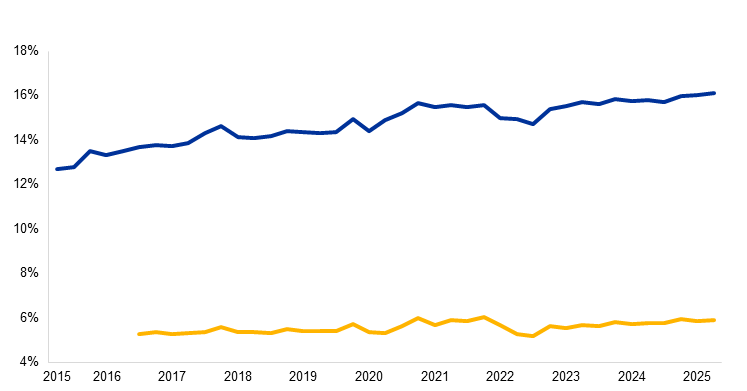
Overall, the euro area banking sector remains well-capitalised. The average Common Equity Tier 1 (CET1) ratio stands at 16.1%, up slightly from last year (15.8%). The leverage ratio has increased marginally and remains just below 6% (Chart 1).[1]
Chart 1
CET1 capital and leverage ratio of significant institutions
Source: ECB supervisory banking statistics.
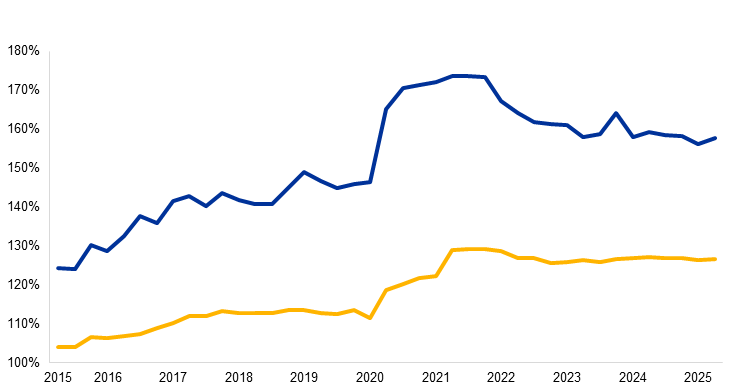
Liquidity positions remain comfortable. The average liquidity coverage ratio stands at 158%, the net stable funding ratio at 127% (Chart 2). Favourable financing conditions are reflected in relatively tight bank bond spreads. However, banks’ growing reliance on market-based funding could pose risks in times of stress.
Chart 2
Liquidity ratios
Source: ECB supervisory banking statistics.
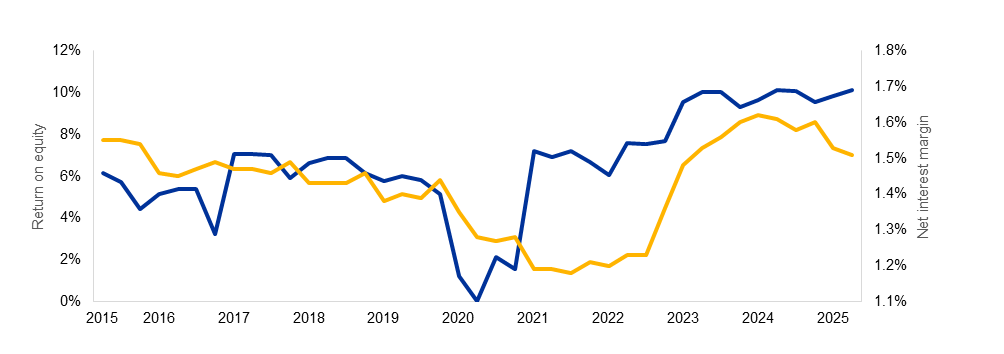
Profitability levels have stabilised. The average return on equity across significant institutions currently stands at around 10% and thus 4.5 percentage points above the levels observed during the period of low interest rates.[2] This increase was largely driven by higher net interest margins, although this effect gradually levels off (Chart 3). Differences across banks and countries remain marked, reflecting varying interest rate pass-through, provisioning dynamics and cost efficiency.
Generally, banks’ cost-to-income ratios declined from 66% in 2020 to 54% this this year, mainly reflecting higher interest rates. Looking ahead, banks will have to weigh cost control against sufficient investment in ICT and cyber-resilience.
Chart 3
Return on equity and net interest margin
Source: ECB supervisory banking statistics.
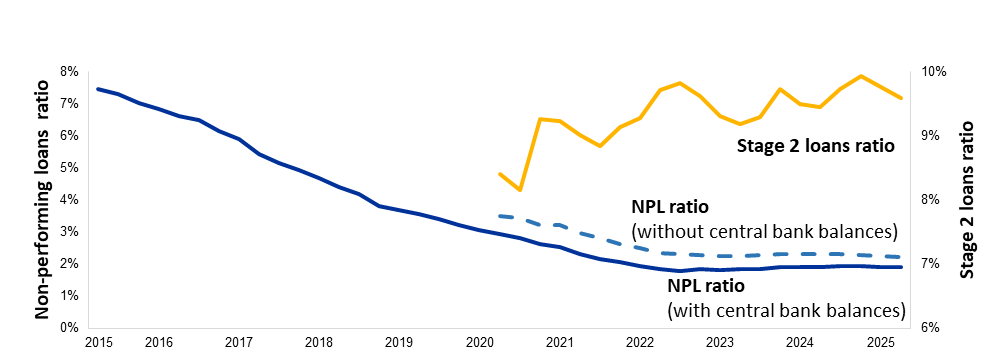
So far, aggregate asset quality has remained sound. The average non-performing loans (NPL) ratio has remained roughly stable at 1.9%, significantly lower than in the past decade.[3] But there are pockets of vulnerabilities: above-average NPL ratios for commercial real estate loans, at 4.6%, and for loans to small and medium-sized enterprises (SMEs), at 4.9%, warrant attention. The ratio of stage 2 loans, which signals an increase in credit risk for performing loans, has trended upwards in recent years (Chart 4).
Chart 4
Non-performing loans and stage 2 loans ratios
Source: ECB supervisory banking statistics.
Note: This chart shows stage 2 loans as a share of total loans and advances; “central bank balances” stands for cash balances and other demand deposits.
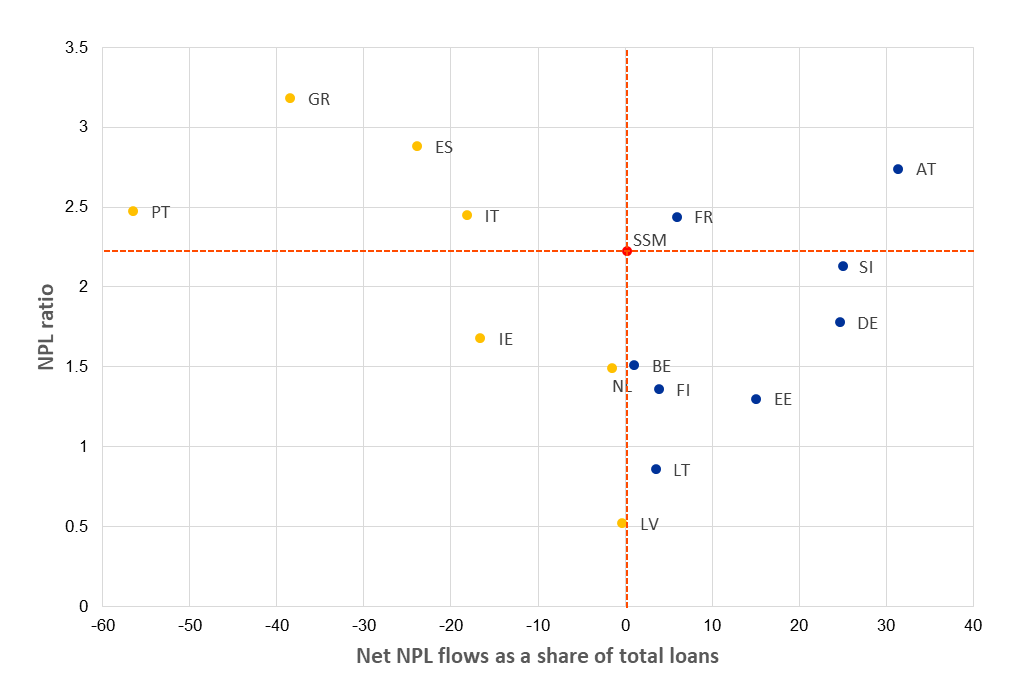
A stable euro area picture masks diverging non-performing loan dynamics across countries; broadly speaking, there has been a declining trend in countries with previously high levels of non-performing loans and an increasing trend in countries starting from lower levels (Chart 5).
Chart 5
Net non-performing loan flows and ratios in the second quarter of 2025 by country
(x-axis: basis points, y-axis: percentages)
Source: ECB supervisory banking statistics
Note: The y-axis shows the non-performing loans ratio excluding cash balances at central banks and other demand deposits in the second quarter of 2025. The x-axis shows the four-quarter rolling net non-performing loan flows as a share of total loans in the second quarter of 2025. Blue dots represent countries which experienced net NPL inflows over the period, while yellow dots represent countries which experienced net NPL outflows. Countries with fewer than three significant institutions are not shown.
Looking ahead, bank profitability remains subject to downside risks from weaker growth, higher provisioning needs and pressure on interest margins. Banks could face higher credit risks if tariffs affect the financial soundness of corporations or if the economy weakens.
SREP assessment and stress test results for 2025
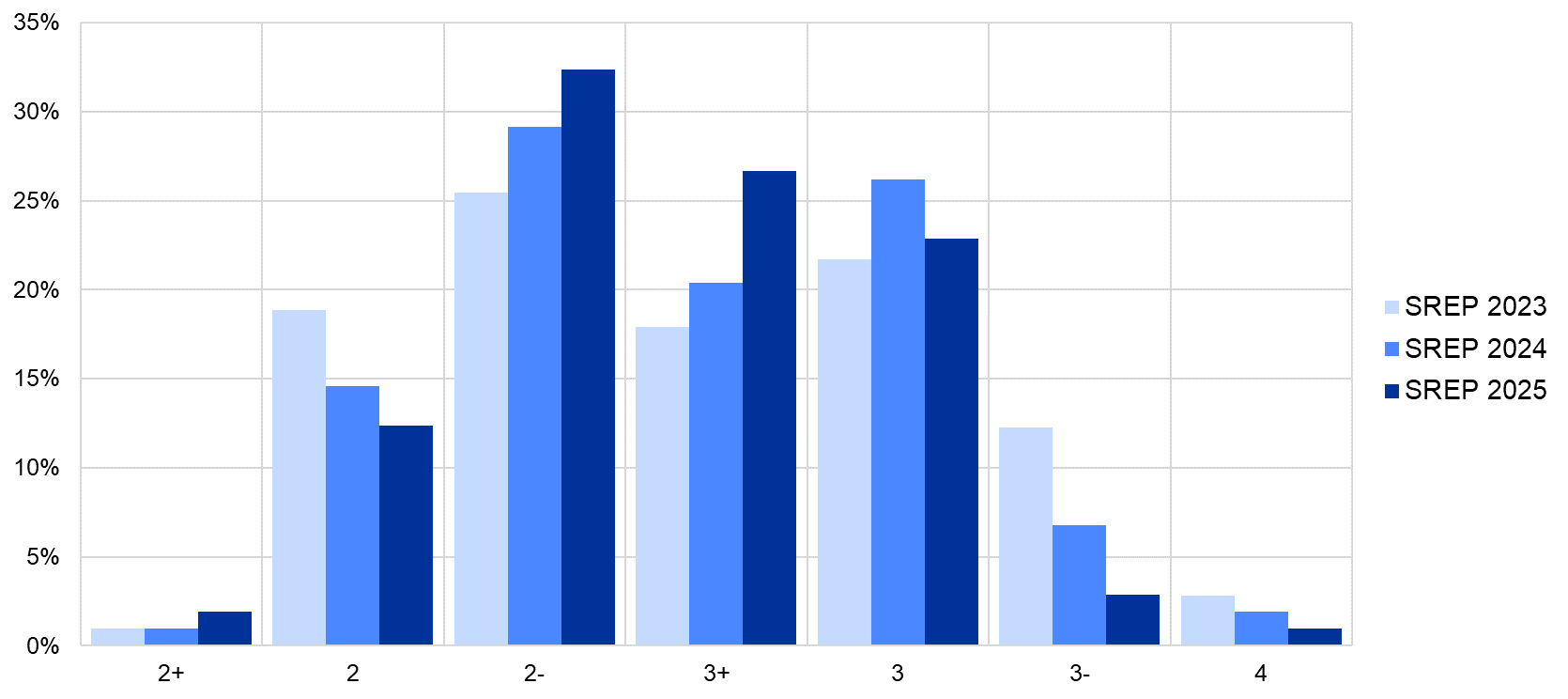
In terms of our supervisory assessment of banks’ risks and risk controls, the average overall SREP score for 2025 has slightly increased compared with last year, moving closer to 2-. The distribution of scores shifted towards the centre: the scores of institutions rated below-average tended to improve, whereas the scores of banks rated above-average slightly deteriorated (Chart 6). Overall, one-quarter of banks remain in the weaker categories (scores 3-4).
Chart 6
Overall SREP scores
Source: ECB SREP database.
Notes: 2023 SREP values are based on assessments of 106 banks, 2024 values on assessments of 103 banks and 2025 values on assessments of 105 banks. There were no banks with an overall SREP score of 1 in 2023, 2024 or 2025.
Qualitative SREP measures to address supervisory findings were issued for 100 banks. The number of new qualitative measures decreased by roughly 30% compared with last year. This reflects our clearer focus on material weaknesses as well as progress made by banks in addressing previous supervisory concerns.
Credit risk remains the most important driver of banks’ risk-weighted assets. Some 40% of supervisory measures focus on credit risk, such as the need for banks to address persisting weaknesses in provisioning policies. We particularly focus on exposures to sectors with relatively high credit risk – for example, commercial real estate or SME lending.
Measures related to internal governance (17%) and capital adequacy (11%) also featured prominently, underscoring the continued supervisory attention to banks’ decision-making frameworks and capital planning processes.
Another 10% of supervisory measures address operational risk related to cyber risks or deficiencies in risk management systems. Moreover, many banks show persistent deficiencies in their internal information systems, which impairs the ability of managers and boards to take well-informed decisions.
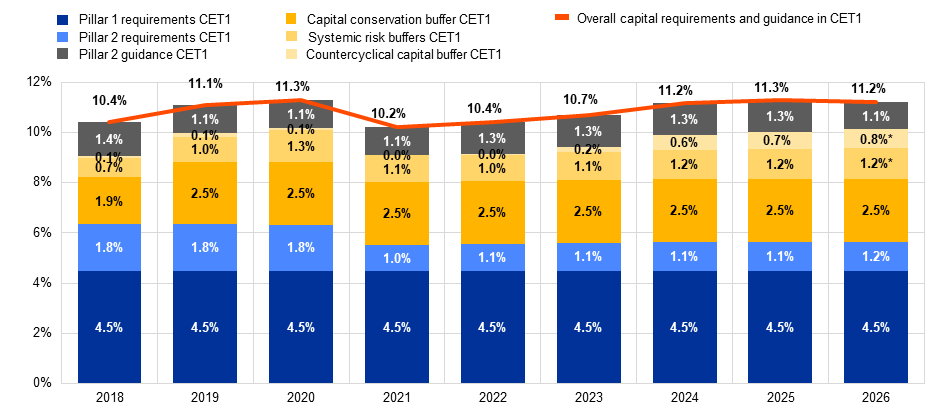
Quantitative requirements complement these qualitative measures. For 2026, the overall capital requirements and guidance applicable to banks under ECB supervision will remain broadly stable at 11.2% of CET1, compared with 11.3% this year (Chart 7).
Chart 7
Developments in overall capital requirements and Pillar 2 guidance
(percentages of risk-weighted assets)
Sources: ECB supervisory banking statistics and SREP database.
Notes: The sample selection follows the approach outlined in the methodological note for the publication of aggregated supervisory banking statistics. For 2018, the first quarter sample is based on 109 entities, for 2019 on 114 entities, for 2020 on 112 entities, for 2021 on 114 entities, for 2022 on 112 entities, for 2023 on 111 entities, for 2024 on 110 entities and for 2025 on 113 entities. For 2026, the sample is based on 109 entities. The Pillar 2 requirements are applicable from January 2026.
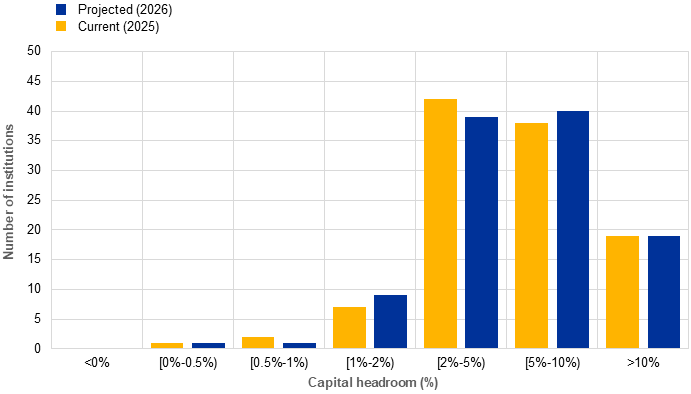
Capital headroom across the system remains healthy: no institution is expected to have capital levels below the required sum of overall capital requirements, buffers and guidance (Chart 8).
Chart 8
Distribution of capital headroom between CET1 capital ratios and CET1 overall requirements and Pillar 2 guidance after the 2025 SREP
Sources: ECB supervisory banking statistics and SREP database.
Notes: Projected capital headroom is based on the 2025 SREP decisions and will be applied in 2026. Current capital headroom is based on the 2024 decisions and applicable in 2025. Pillar 2 CET1 requirements and Pillar 2 guidance are, as per the published list of Pillar 2 requirements, applicable as of the first quarter of 2026. CET1 ratios are as at the second quarter of 2025 and adjusted for AT1/T2 shortfalls. For systemic buffers (global systemically important institutions, other systemically important institutions and systemic risk buffers) and the countercyclical capital buffer, the levels shown are those anticipated for the first quarter of 2026 and included in 2026 CET1 requirements and guidance. CET1 ratios have been adjusted for AT1/T2 shortfalls.
Our assessment of bank-specific risks is reflected in broadly stable Pillar 2 requirements: in 2026 an average Pillar 2 requirement of 1.2% of CET1 will apply, which is slightly higher than that applicable in 2025 (1.1%).
Pillar 2 requirements capture risks not covered or insufficiently captured by Pillar 1 requirements, which set the minimum capital that all banks must maintain against credit, market and operational risks. When setting the Pillar 2 requirement as a legally binding requirement determined through the SREP, we assess which risks are captured under Pillar 1 and apply Pillar 2 only to risks that are insufficiently covered. For example, interest rate risk in the banking book falls outside the standard Pillar 1 framework.
In past years, the ECB has applied targeted P2R add-ons in areas such as insufficiently provisioned non-performing exposures and leveraged finance exposures. In 2025 the number of banks subject to the NPE and leveraged finance add-ons declined, as some banks remediated previous findings. Nine banks were subject to an add-on for insufficiently provisioned non-performing exposures – down from 16 last year. For six banks, the Pillar 2 requirement included a leveraged finance add-on – down from nine last year. In parallel, the ECB applied a leverage ratio Pillar 2 requirement to 14 banks because of an elevated risk of excessive leverage – up from 13 banks last year.
Pillar 2 guidance will decline to 1.1% on aggregate in 2026, compared with 1.3% in 2024 and 2025.[4] Pillar 2 guidance is informed by the EU-wide stress test 2025, the adverse scenario of which was motivated by higher geopolitical risk and escalating trade tensions.
The small decline in Pillar 2 guidance reflects two factors.
First, in the adverse scenario, aggregate losses would increase by 14% to €628 billion. Non-performing loans would increase to 5.8%, reaching levels last seen in 2014.[5]
Second, higher profits would absorb part of these losses. The overall capital depletion would be about 100 basis points lower than in the stress test conducted in 2023.
While P2G is not binding, it serves as a key reference for assessing banks’ capital resilience. For example, banks’ distributions need to be anchored in sound capital planning under credible baseline and adverse scenarios.
Data collected during the stress test also provide information on the effects of Basel III implementation. Transitional agreements significantly reduce the initial impact: on aggregate, the impact of the Capital Requirements Regulation 3 (CRR3) on banks’ capital requirements was close to zero in 2025.[6] Capital requirements even declined for some banks. Since the beginning of this year, European banks have had to comply with CRR3, which implements the internationally agreed Basel III rules in Europe. A key element is the output floor, which limits how much banks can reduce their capital requirements by using internal models, rather than the standardised approach, to calculate risk weights.
Banking sector resilience and the real economy
Several factors are behind the current resilience of the euro area banking sector.
Over the past decade, improved regulation, supervision and risk management of banks have made the banking system better capitalised and more resilient.
Moreover, firms and households have remained financially sound even though the European economy has been hit by severe shocks over the past years. A robust labour market has underpinned household incomes and debt servicing capacity, supporting asset quality.
Not least, there was sizeable fiscal support to households and firms, with fiscal packages during the pandemic amounting to 4% of GDP in the euro area.[7] In subsequent years, measures introduced to shield against energy price shocks were in a similar range.[8] Indirectly, these measures have protected the financial sector from higher credit losses during recessionary periods.
This needs to be considered when assessing banks’ resilience to future shocks. With fiscal policy becoming more constrained, the financial sector needs to have strong buffers. In a stress scenario, banks that are unable to raise additional equity would otherwise have to scale back their activities.
Maintaining capital buffer requirements thus remains important for preserving resilience.[9] In this regard, macroprudential policy complements our work by addressing risks to financial stability arising from second-round effects and contagion. Since the pandemic, macroprudential buffers that can be released in times of stress have increased. The average level of the countercyclical capital buffer in CET 1 applicable in 2026 stands at 0.8% of risk-weighted assets.
Over time, improved capitalisation has sustained banks’ ability to service the economy. Since the global financial crisis, the share of equity capital in banks’ funding sources has increased. The share of bank loans as a key financing source for the European economy in 2024 was at roughly the same level as at the beginning of the century (Chart 9).
There are currently no signs of widespread losses or credit supply constraints arising from capital requirements.[10] Recent ECB analysis confirms that well-capitalised banks provide more stable funding to the real economy. Also, banks’ profit efficiency increases with better capitalisation up to an estimated capital level of 18% – a point that remains above current average capital levels.[11]
Chart 9
Bank equity and lending
(left-hand scale: percentage of GDP; right-hand scale: percentage of total assets)
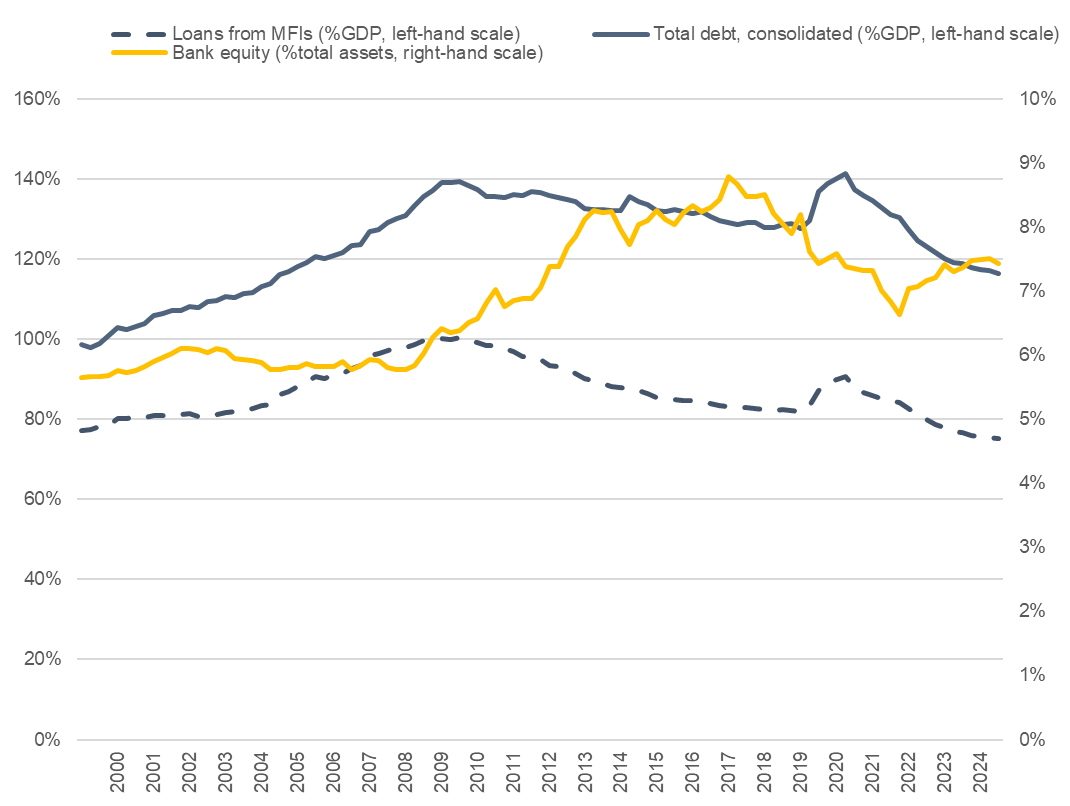
Sources: Eurostat, ECB and ECB calculations.
Notes: MFI stands for "monetary financial institutions”. Consolidated gross debt is defined as total gross debt minus loans granted by firms and households. The latest observations are for the second quarter of 2024.
Priorities for maintaining resilience
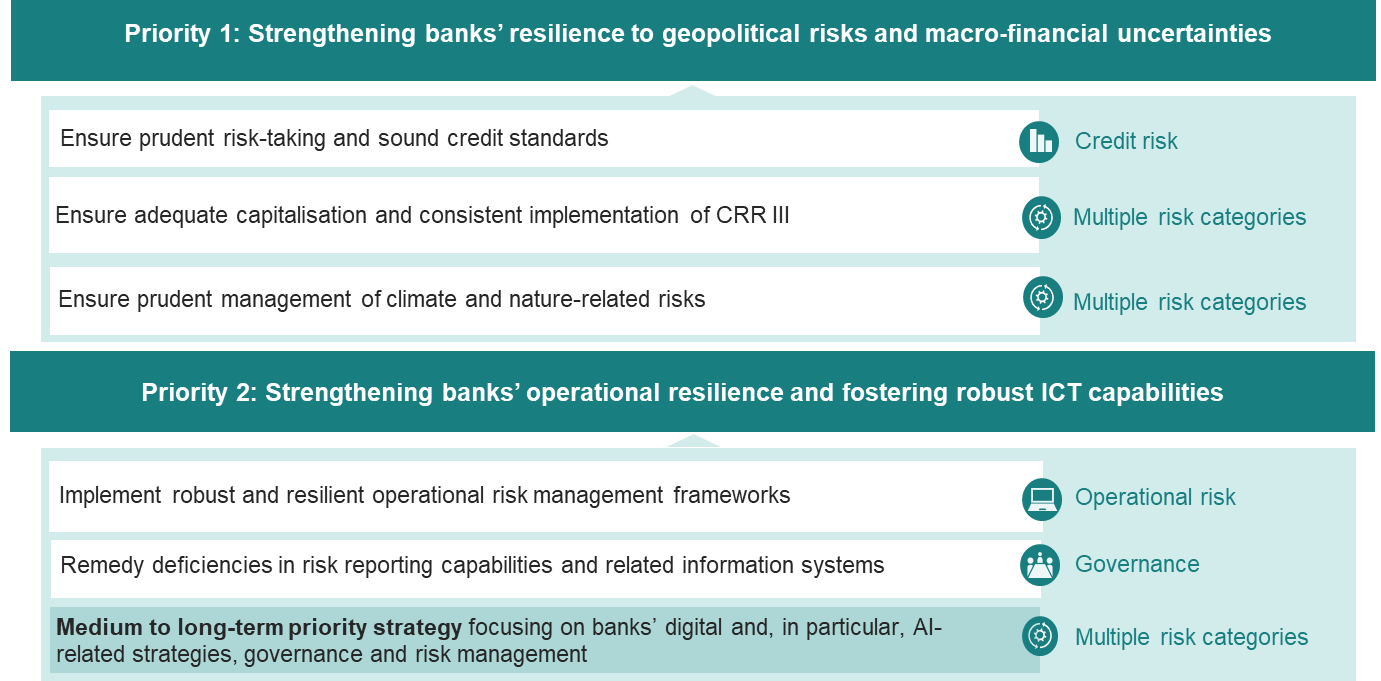
Over the next three-year cycle, we have two supervisory priorities focusing on the resilience of the euro area banking sector (Figure 1).
Figure 1
The supervisory priorities for the years 2026-28
Source: ECB.
Strengthening banks’ resilience to geopolitical risks and macro-financial uncertainties is our first priority. Currently, economic policy uncertainty is elevated. However, this is hardly reflected in market-based indicators of financial stress, creating the risk of an abrupt repricing of risk (Chart 10).
Banks thus need to adopt sound credit standards, maintain adequate capitalisation and manage climate and nature-related risks prudently. A reverse stress test will be conducted next year to identify bank-specific geopolitical scenarios that could severely affect the financial situation of individual banks.
Chart 10
Measures of uncertainty in the euro area
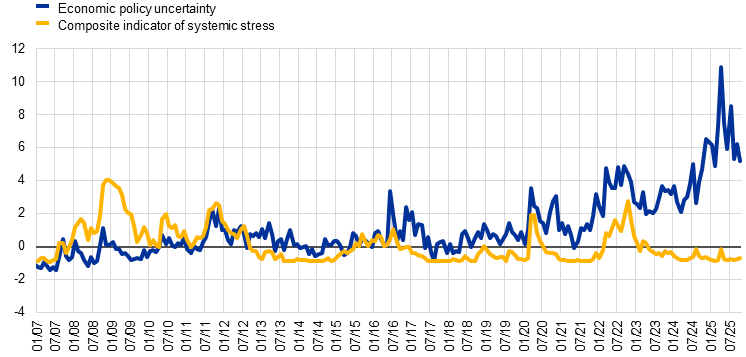
Sources: ECB, policyuncertainty.com and ECB staff calculations.
Notes: The composite indicator of systemic stress and the economic policy uncertainty index are monthly data series (standardised by the standard deviation from the mean over the period January 1999-December 2019). A value of 2 should be taken to mean that the uncertainty measure exceeds its historical average level by two standard deviations. The latest observations are for August 2025.
Our second priority is related to banks’ operational resilience and robust ICT capabilities. Banks need to have resilient operational risk management frameworks and remedy deficiencies in internal risk data systems. In addition, we will focus on banks’ digital and AI-related strategies.
To deliver on these priorities, we are adapting the ECB’s supervision to make it more efficient and effective while maintaining a clear focus on relevant risks.
These reforms have four elements.
First, the reform of the SREP, which I described here last year, is a core component. It is well on track, and its effects are already visible. This year, for example, SREP decisions have been issued sooner and are more focused.
Second, in our Next Level Supervision project, we are streamlining all supervisory activities, including on-site inspections, decision-making procedures and stress-testing. We are removing overlaps and increasing proportionality in reporting.
Third, a project on supervisory culture ensures that these reforms are implemented throughout the banking union in an integrated way.
Fourth, we are monitoring and evaluating the effectiveness of our supervision.
These initiatives are essential in retaining a strong and competitive banking sector.
Yes, the environment is challenging. Uncertainty is high. Digitalisation is progressing rapidly. For European banks, the best response is to retain their financial and operational resilience. This strengthens their long-term business models – and makes them more competitive.
Looking beyond supervision, in responding to global developments, policymakers should prioritise maintaining resilience and promoting the Single Market. Finalising the banking union, particularly introducing European deposit insurance, remains essential.
There is clearly room for “more Europe”. Many rules related to bank governance and insolvency legislation remain fragmented across Member States.[12] Greater harmonisation would support integration and the efficiency of the banking sector alike. Harmonisation and simplification are two sides of the same coin.
At the same time, Europe should remain committed to global standards, just as we remain committed to closely cooperate with our international partners.
On our part, we will ensure an efficient, effective and risk-based supervisory framework. This helps sustain trust in European banks among investors and depositors. Any move to weaken standards would instead weaken the resilience and competitiveness of European banks.
Thank you very much for your attention. I look forward to your questions.
I have two questions. The first will come under the next-level supervision bucket. What specifically will you change in how you conduct on-site investigations? Will they be fewer in number? Will there be a greater role for the JSTs versus the horizontal teams? That would be super to spell out.
And then the second, I guess, you could put under the close coordination with international authorities bucket. There was a difference of opinion in the Basel Committee last month on whether the banking union is actually and should be treated as a single jurisdiction when looking at G-SIB buffers. What reassurance can you give big banks today with cross-border businesses that this will still be the case going forward, so that they can plan accordingly and not see their G-SIB surcharges rise as a result?
Thank you very much for these questions. The first one is related to on-site inspections. So let me maybe explain what these on-site inspections are very briefly and how we currently organise them. On-site inspections are a tool that we use if we really want to understand what’s going on within the bank. They’re typically requested by the Joint Supervisory Teams. So they of course do their off-site supervision, they see that there’s a specific area where they would like to dig deeper and then they request on-site inspection. This is always coordinated with the Joint Supervisory Teams. On-site inspections predominantly are staffed by colleagues from the national competent authorities. Around 85 or 90% of the colleagues come from there, so you can imagine that it’s quite a planning process, which we actually do very diligently because it’s very resource-intensive. We can do better in terms of organising this – in terms of having consistent communication vis-à-vis the banks. This is something that we’re doing already. We have an integrated planning process – so again, coordinating the off-site and the on-site work – but we also received feedback from the banks, and this is very well taken because we want to hear from them how they perceive our supervision. We also heard feedback that there’s room for improvement: we can better coordinate this and we can better speak with one voice. And this is basically, in a nutshell, what we’re doing: improving upon the procedures that we have now and applying also the risk tolerance framework that we have for the other activities. You’ve seen it briefly in the slides for the SREP reform: we have a risk tolerance framework where we say we do not have to look at every risk for every bank with the same intensity every year, and the same of course also applies to on-site inspections. And we have now a lot of consensus, I would say, around the table to go in that direction and to be more targeted because on-site inspections are also resource-intensive for us and we want to make them more integrated. One last word: we also use a lot our SupTech tools to make that possible because we often get a lot of information from the banks for the inspectors that they have to go through and makes it much easier for us to understand what is available in-house, what do we get from the banks, what do we need in addition. So these are basically the areas where we improve.
Your second question was related to a discussion, and this was also partly covered in the media, about an agreement that was reached in the Basel Committee in 2022 of how progress that has been made in the banking union is treated when it comes to not the designation of globally systemically important banks, but the calibration of the buffers – the additional capital buffers. And here the agreement was that cross-border activity within the banking union is acknowledged as 66% domestic. This is what we’re currently applying, and I would say that we’re also in a very good dialogue about this. I think it makes fully sense to acknowledge the progress that has been made in the banking union, and this is where we are. With the EBA, it has also been clarified how this is applied in Europe.
My first question is on government measures all around Europe that have slowed down the consolidation in the banking sector. What is your opinion on those, and do you think they could be an obstacle to the banking union?
Secondly, I’d like to know your view about the simplification of rules in the banking sector and especially on the simplification of capital requirements and the capital stack. What is your view on this topic?
Thank you very much for these questions. As to the first one, I understood this as related to consolidation in the banking sector and cross-border mergers. I think we’ve always made very clear what our role is in approving cross-border merger applications that come to us. We have very clear criteria that are given to us in the legislation. We look at prudential ratios, governance and so forth, and we certainly – and I’ve said this before – don’t stand in the way of cross-border merger activity. Of course, we need to acknowledge the risks, but we also know that there are many benefits coming from cross-border activity and a more integrated market leveraging upon the single market. I would not want to comment on specific government measures – this is not in the prudential remit – but I think we are very clear on what our role is and how we are viewing this.
As regards simplification and the capital stack, we’ve always said that we are very open to this, if there are ways to improve the capital framework. Again, we would certainly not stand in the way, but of course we need to make sure that resilience is maintained and that whatever is being decided is in line with the Basel framework. That’s important for the European banks that are active globally. And it also needs to make sure that the division of labour between microprudential and macroprudential is maintained.
My first question is about the AI boom. Given an exceptional boom in the sector and investments, I’m curious if this is coming up on your radar. Are you looking at banks investing in data centres and AI? Is this just normal supervision, or are you looking at the sector more closely than previously?
The second question is about stablecoins, given that plenty of members of the Governing Council have warned about the liquidity risk related to stablecoins, particularly in case of multi-issuance. You know, if there is a run, could that create a liquidity challenge for a eurozone bank? How do you see that risk? How acute is that risk? And what are you doing to mitigate that risk?
Thank you for those questions, which are both a little bit in the space of digitalisation, which I said is really one of our clear priorities to look into. What does it mean for banks and how prepared are they? There are business opportunities, but there are also risks. Maybe I was a bit short on our priorities. Actually, looking into AI strategies of banks is within our second priority. Operational resilience is one of the themes that’s clearly high on our list and will also be a priority for the next three years. Of course, many banks are experimenting with AI tools to become more efficient, to deliver better services and to do better credit risk assessment, but we all know that there can also be risks associated with it. There can be discriminatory lending practices that are promoted by AI. There can be also fragilities in the IT process and so forth. So we want to understand this whole picture better and also then work with the banks to make sure that the potential risks that are there don’t become prevalent. We are, by the way, also using, when I mentioned SupTech tools, tools like large language models in our own work because we can’t just theoretically discuss these issues, but we also need to understand how these tools work in practice.
When it comes to stablecoins, it’s again, I would say, a digital innovation that is happening. If you want, it’s a combination between the money market funds and the payments mechanism. You may argue that since we have payment systems that function well in Europe, the business case is a bit weaker here than in other world regions. I don’t want to speculate about this, but in any case, like any digital innovation, I think it needs to be well regulated because there can be, as you mentioned, volatility issues. There can be issues in particular in times of crisis. And this is why I think it’s good that Europe has the MiCA Regulation. It’s also good that other jurisdictions are regulating stablecoins, but there can be cases where regulation elsewhere is weaker and different than in Europe. And this is where joint issuance and the full fungibility can create issues for also the euro area banks. So far, this is relatively small in terms of volume, but of course regulation also needs to be preventive. And this is why, I think, what the ESRB recommendation said – I think it was issued last month – that if there are differences in regulation across jurisdictions then there should be equivalence arrangements and reciprocity arrangements. This is a good way forward to make sure that the benefits that are there can be reaped. So we certainly don’t stand in the way of technological innovation, but also that the risks are being contained.
I’ve got two questions. The first one is on the new methodology for the P2R. If you had to calculate this year’s capital requirement with the new methodology, would there have been any differences?
And the second one is on Russia. Can you give us an update on the progress the banks have been making in the last 12 months to exit Russia and how happy you are with them?
Thank you for the question on the new P2R. I think the methodology was published today, and it’s indeed important to understand what it is and what it is not. So what it is: it’s in line with the SREP reform to become simpler and to be more targeted, also vis-à-vis the banks. So this was our attempt, because the previous P2R methodology, I think, was technically very, very good, but it was also complex, and so we wanted to be simpler so that also the communication to the banks is more clear. So what remains is that the SREP scores will remain the main driver of the P2R. There will be a stronger link to the SREP scores, but this will be still the main philosophy behind the P2R. The reliance on the ICAAP – the banks’ internal capital allocation models – will be a little bit weak. Of course, we will still look at it. And it will also be easier to integrate deficiencies, for example in governance, into the calculation of the P2R. There will be more room for constrained judgement. I published a blog earlier, and this is also explained in the publication that we did today. And of course, we will evaluate very closely how this judgement is being used. So it’s, of course, capital regulation. The P2R is not just mechanical. We need judgement, but we need to also assess how judgement is being used. So what we did this year: we used basically the data that we have from the banks for this year. This year, SREP is still calculated with the old methodology, but we also used the new methodology, so to say, in a dry run to see what the result would be if we had used it. And we made sure that in this dry run there wouldn’t be any abrupt change in capital just because of the methodology. So this is what was done. And now we’ve done this, and we’re checking all this very carefully. And then next year, we will use the new methodology to calculate the P2R. And I think it should also be more transparent for the banks.
As to the second question: yes, we monitor this very carefully. So now I think the latest number is that the exposures are down by 61% or so. I would not use the word happiness because it was a very difficult situation. We are working very closely with the banks. And I think also the banks have understood why the measures that we took were necessary. So this is on a good track. But of course we monitor the situation very carefully.
I have a question on climate specifically – a two-parter. First of all, how prepared are European banks for the requirement that they will start having their own transition plans for the transition to a low-carbon economy or zero-carbon economy?
And then secondly, how hard is it to keep them motivated and focused on this topic now that we have not just the US, but other jurisdictions as well, placing less of an emphasis on transition and, at best, placing more of an emphasis on mitigation?
Frank Elderson: I’ll start with the second question. I think now, in comparison to, say, five or six years ago, where – I remember in 2019 I think it was – less than 25% of the banks had actually done any, I would say, serious work on climate and nature-related risk management – because that’s what we are talking about – now, more than 90% – and this is the number from already, I think, a year ago, so maybe it’s even higher – of banks have very explicitly said that for them, climate and nature-related risks are material. So I think there’s no need for us to be a kind of cheerleader, because they know for themselves that this is material. So that would be, I think, the answer to your second question.
As to the first question on how well prepared banks are and more specifically on transition plans, I would say also there: if you compare where banks were in 2019 when we came out, in 2020 with our expectations, all the things that we have done and that I have been talking about for quite some years, I think banks have progressed a lot. Actually, you might have seen that some months ago I came out and I specifically thanked the banks, which is not something that supervisors normally do publicly, for the progress that they have made. So that also means that the way that we will look at specifically transition planning will not be, as of yet, a big, large, horizontal push like we did some years ago, because we really felt that banks needed to step up to the challenge, which they have done. So what we will do next year is engage with banks, have lots of conversations, see how they are going to be implementing the transition plans that you referred to. So we will take it from there, and I think that the work that has been done so far, all the banks now having done a materiality assessment, banks having moved forward on our expectations, I think that puts them in a good place.
I have a very broad question, which is about excess liquidity provided by the ECB. It has dropped by two trillion over the years, but it’s still quite high. How far are we from that point where excess liquidity can no longer decline and still provide the necessary funding for the banking system? When could we reach that point where excess liquidity should no longer drop further? Is this going to come in 2026, and what is the level you think is the minimum that’s going to be required?
You’ve seen the liquidity indicators, and I will say something on this in a second. But this is of course a question which is also related to monetary policy. As you know, we have the separation principle, so I don’t comment on the liquidity provision through the ECB. What I can say is when you look at the indicators for the banks – the liquidity indicators – they have been very stable over the past years almost. They were a bit higher a few years ago, but then recently they’ve really stabilised. And I think this is good news because there was also the concern with the move from QE to QT that this would have implications for the liquidity position of the banks, but this has not happened. So European banks are liquid. All the liquidity indicators are in a very good range. And I must say also when you look at the tensions that we had on markets – I mentioned this earlier – around the tariff announcements and then the revaluation of assets, there was also maybe a short-term concern that it might also affect the liquidity of the banks. But also there we’ve seen that the banks could deal with this short-lived stress on the markets quite well. We monitor this very carefully. As you know, since 2023 we have had weekly liquidity monitoring, which gives us much more timely information. And we’ve also told the banks, and we’re also public with that, that of course they need to prepare also for the changes in the monetary policy environment. They need to be prepared and they need to pre-position collateral, but all this is going very smoothly right now, and you see it basically also in the data.
At the end of the second quarter of 2025, the leverage ratio stood at 5.9%, up from 5.8% at the end of the second quarter of 2024.
This is the period 2015-22. The latest information is available for the second quarter of 2025, with an average of 9.9% across the previous four quarters.
This figure is derived from ECB supervisory banking statistics.
Pillar 2 guidance is measured in terms of CET1 capital. The requirements for 2024 and 2025 were informed by the stress test conducted in 2023.
As the stress test looks at losses accumulated over three years, this number would apply to the end of 2027.
The ECB’s impact assessment, based on a sample of 85 banks, shows that the average increase in minimum required capital would be small at just 0.8%. The impact on the CET1 ratio would be close to zero (-30 basis points) at an aggregate level in 2025, the year in which CRR3 came into effect.
The fiscal support in the euro area amounted to around 4% of GDP in 2020 and 2021, of which approximately two-thirds consisted of direct support to firms and households. For details, see Girón, C. and Rodríguez-Vives, M. (2021), “The role of government for the non-financial corporate sector during the COVID-19 crisis” Economic Bulletin, Issue 5, ECB.
The corresponding numbers are around 1.9% of euro area GDP in 2022 and 1.8% in 2023. See Checherita-Westphal, C. and Dorrucci, E. (2023), “Update on euro area fiscal policy responses to the energy crisis and high inflation”, Economic Bulletin, Issue 2, ECB,
ECB (2025), Governing Council statement on macroprudential policies, 7 July.
ibid.
See Financial Stability Board (2024), “Assessing the effects of reforms”, and Bank for International Settlements (2022), “Evaluation of the impact and efficacy of the Basel III reforms”. The link between capital requirements and efficiency was recently analysed by Behn, M. and Reghezza, A. (2025), “Capital requirements: a pillar or a burden for bank competitiveness?” ECB Occasional Paper Series, No 376, ECB, Frankfurt am Main, October.
ECB (2025), ECB Guide on options and discretions available in Union law, July.
Europeiska centralbanken
Generaldirektorat Kommunikation och språktjänster
- Sonnemannstrasse 20
- 60314 Frankfurt am Main, Tyskland
- +49 69 1344 7455
- media@ecb.europa.eu
Texten får återges om källan anges.
Kontakt för media