


Annual Report on sanctioning activities in the SSM in 2025
Introduction
This report has been prepared by the SSM Network of Enforcement and Sanctions Experts to present comprehensive statistics on sanctioning activities carried out in 2025 by the ECB and the national competent authorities (NCAs) of European Union (EU) Member States participating in the Single Supervisory Mechanism (SSM) in relation to breaches of prudential requirements.
The report looks at formal sanctioning proceedings conducted by competent authorities within the scope of their respective powers,[1] providing data on the administrative penalties that were imposed for breaches of prudential requirements on supervised entities, other legal persons and natural persons falling within the scope of prudential supervision in the context of the SSM.[2] The report does not cover enforcement measures such as periodic penalty payments.
The report presents aggregate statistics for the whole of the SSM. Data have been collected and compiled using standardised categories to ensure that information is harmonised and comparable.[3]
Main findings
In 2025 the ECB and the NCAs (hereafter “the SSM competent authorities”) conducted a total of 370 sanctioning proceedings, 66% of which were completed during the year. Of these, up to 89% were finalised with a decision to impose a penalty or an ECB request pursuant to Article 18(5) of the SSM Regulation to open sanctioning proceedings. Proceedings relating to natural persons continued to account for the majority of proceedings (55% of all proceedings handled, of which 74% were completed during the year). Also, 63% of proceedings finalised with a decision to impose a penalty or a request to open sanctioning proceedings concerned natural persons. The highest penalties were nevertheless imposed on significant institutions (SIs) and less significant institutions (LSIs).[4]
By the end of the year, a total of 152 administrative penalties were imposed, with pecuniary penalties accounting for 86% of the total. This increase in the proportion of pecuniary penalties is in line with the trend from previous years. The total fines collected reached approximately €57.15 million, making it the highest total in comparison with the previous five years. The largest pecuniary penalties, amounting to €15 million each, were levied on two SIs. Among other categories, the highest fines were €7.67 million for an LSI and €0.2 million for a natural person. The remaining 14% of penalties were non‑pecuniary in nature.
Most sanctioning proceedings conducted and finalised with penalties in 2025 continued to concern breaches of prudential requirements in the area of internal governance, in line with the SSM supervisory priorities for 2025-27. In addition, a significant number of sanctioning activities were conducted in relation to capital requirements and large exposure breaches. There were also a considerable number of proceedings relating to reporting and breaches of national prudential requirements.
Data on formal proceedings that were ongoing at the end of 2025 suggest that governance is likely to stay a focal point in terms of SSM sanctioning activities going forward, similar to previous years. It is also among the supervisory priorities for 2026-28.
Overall, a higher number of proceedings were completed compared to 2024, and the proportion concluded with penalties or an ECB request continued its upward trend since 2021, reaching 89% of completed proceedings. In addition, the total amount of penalties reached its highest level in 2025.
Chart 1
Breakdown of proceedings concluded with penalties or an ECB request and total amount of penalties
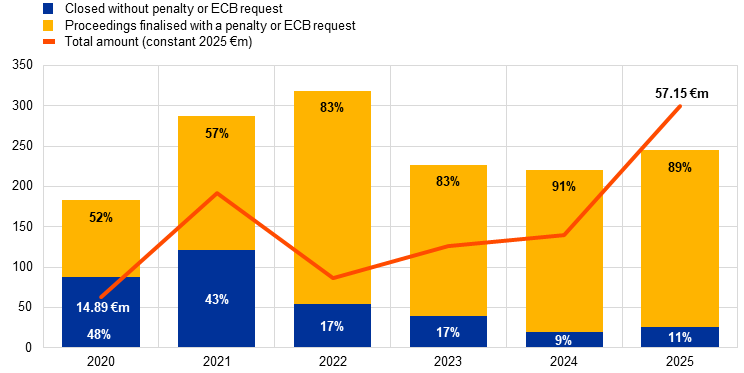
Note: Penalty amounts have been adjusted for inflation and expressed in constant 2025 euros using the Harmonised Index of Consumer Prices (HICP) for the euro area, as published on the ECB website. The corresponding nominal (non-inflation-adjusted) total amount in 2020 was 12.15 €m.
Sanctioning proceedings conducted in 2025
Overall figures
At the beginning of 2025, 217 formal sanctioning proceedings[5] were actively being conducted by the SSM competent authorities (Table 1). Of these, 24 had been opened in previous years by NCAs acting at the ECB’s request pursuant to Article 18(5) of the SSM Regulation. A total of 153 new formal sanctioning proceedings were then opened in the course of 2025.[6]
Table 1
Numbers of formal sanctioning proceedings in 2025
Total number of proceedings | Proceedings originally initiated at the ECB’s request | |
|---|---|---|
Ongoing at the start of 2025 | 217 | 24 |
Suspended at the start of 2025 | 216** | 123 |
Newly opened in 2025 | 153 | 7 |
Total handled in 2025 | 370 | 31 |
Completed in 2025 | 245 | 26 |
of which finalised with a penalty | 219 | 26 |
of which closed without a penalty | 26 | 0 |
Ongoing at the end of 2025 | 125 | 5 |
* This number does not include three proceedings which were erroneously reported in the 2024 Annual Report. It also excludes the suspended proceedings, which are listed separately.
** This figure comprises 216 proceedings that were suspended prior to 2025 owing to criminal proceedings pending before national courts against the same person(s) in connection with the same facts. These proceedings remained suspended at year-end.
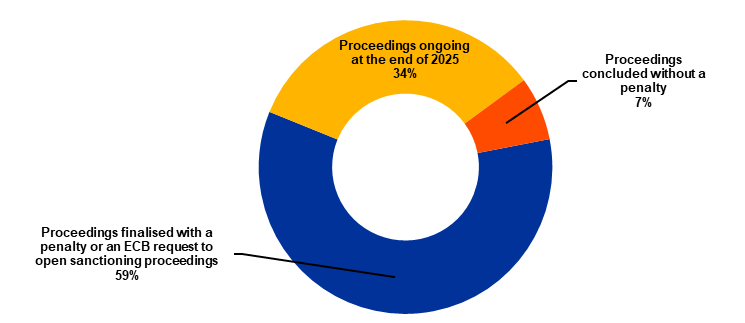
Including proceedings that were ongoing at the beginning of 2025, the SSM competent authorities handled a total of 370 formal sanctioning proceedings over the course of the year. Of those, 245 were completed in 2025, while 125 remained ongoing at the end of the year.
More than half of all proceedings handled in 2025 related to breaches in the area of internal governance (53%), with the next largest shares relating to capital requirements (11%), large exposures (10%) and reporting (8%). The focus on internal governance can be explained by the commitment of the SSM competent authorities to address identified issues at their root. Indeed, good governance plays a critical role in ensuring the safety and soundness of supervised entities. Its importance has also been consistently reflected as an SSM supervisory priority over the years. By penalising supervised entities and their officials, also illustrated by the increase in proceedings and penalties against natural persons, the SSM competent authorities aim to deter poor practices, encouraging institutions to adhere to high standards of accountability, risk management and compliance.
Chart 2 presents a breakdown of the proceedings conducted in 2025 by area of infringement.
Chart 2
Breakdown of formal sanctioning proceedings conducted in 2025 by area of infringement
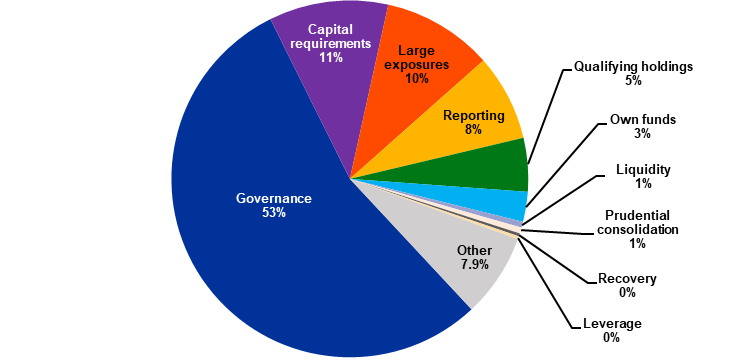
Note: “Other” consists mainly of breaches of national prudential requirements.
In the area of internal governance, the sanctioning proceedings conducted in 2025 predominantly related to (i) risk management and internal controls, which remained the largest category in line with previous years, and (ii) remuneration policies and committees, which became the second-largest category.
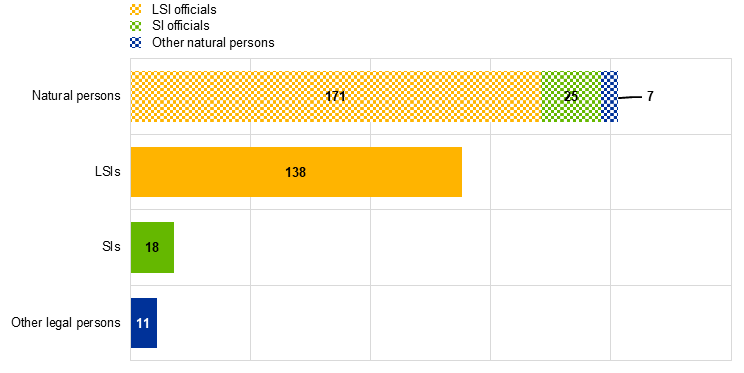
As regards the types of person that were the subject of proceedings, these comprised SIs, LSIs and their officials, as well as legal persons other than SIs or LSIs. Specifically, 55% of the 370 proceedings handled in 2025 concerned natural persons (84% of whom were officials at LSIs[7]). The second largest group concerned was LSIs, in 37% of proceedings handled.[8] The other 8% of proceedings conducted in 2025 concerned SIs and other legal persons falling within the scope of the SSM. Chart 3 presents a breakdown of the proceedings conducted in 2025 by type of person.
Chart 3
Breakdown of formal sanctioning proceedings conducted in 2025 by type of person
Proceedings completed by the end of 2025
A total of 245 formal sanctioning proceedings were completed in 2025 (66% of the total number handled). Each of those proceedings ended with either a decision to impose a penalty, an ECB request pursuant to Article 18(5) of the SSM Regulation addressed to the relevant NCA to open sanctioning proceedings, or a decision to close the proceedings without imposing a penalty (Table 1 and Chart 4). The other 125 proceedings were still ongoing at the end of the year.
Chart 4
Outcome of formal sanctioning proceedings conducted in 2025
See Section 3 for further information on the proceedings finalised with a penalty.
Of the 370 proceedings handled in 2025, 26 (7%) were closed without a penalty being imposed.[9] As regards the grounds for closing, in 19 proceedings the alleged breaches were not considered to be sufficiently material or severe, in view of policy considerations taken into account by the national legislator or the respective competent authority when deciding which breaches should be pursued. Three proceedings were closed because, upon closer assessment, it was concluded that no breach had been committed, while four were closed on other grounds, such as due to the application of statutory limits and the termination of proceedings against natural persons and a decision to pursue the supervised entity instead.
Most of the proceedings that were closed without a penalty related to alleged breaches in the areas of qualifying holdings (39%) and internal governance (31%).
Proceedings ongoing and suspended at the end of 2025
At the end of 2025, 125 formal sanctioning proceedings (34% of the total number handled) were still ongoing, although the majority of these had reached an advanced procedural stage. Five of the proceedings had been opened by NCAs at the ECB’s request pursuant to Article 18(5) of the SSM Regulation.
These proceedings mainly relate to suspected breaches in the areas of internal governance (60%), followed by capital requirements (9%) and reporting (9%).
In addition, 216 proceedings opened and suspended prior to 2025 (of which 123 had been opened by NCAs at the ECB’s request in previous years pursuant to Article 18(5) of the SSM Regulation) continued to be suspended at year-end, as shown in Table 1.[10]
Administrative penalties imposed in 2025
Overall figures
Of the 245 formal sanctioning proceedings completed in 2025, 219 (89%) resulted in the imposition of a total of 152 administrative penalties (131 pecuniary and 21 non-pecuniary)[11]. Chart 5 presents an overview of the administrative penalties that were imposed by the SSM competent authorities in 2025 for breaches of prudential requirements.
Chart 5
Administrative penalties imposed by competent authorities in 2025
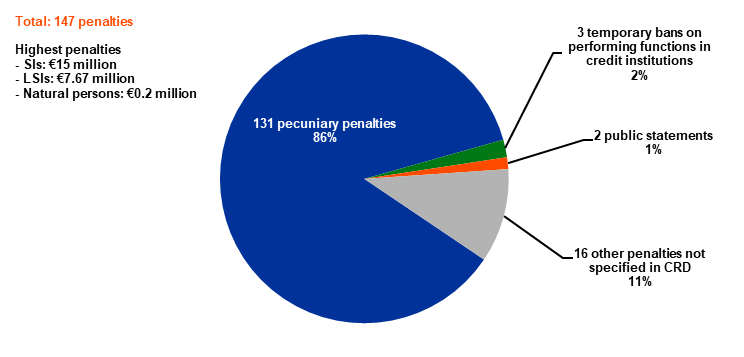
More than half of the administrative penalties imposed were for breaches relating to internal governance (53%), followed by large exposures (13%) and capital requirements (13%), reporting (8%), and others with smaller shares (own funds (4%), qualifying holdings and recovery (1%), and other (8%)). Chart 6 presents a breakdown of administrative penalties in 2025 by area of infringement.
Chart 6
Breakdown of administrative penalties imposed in 2025 by area of infringement
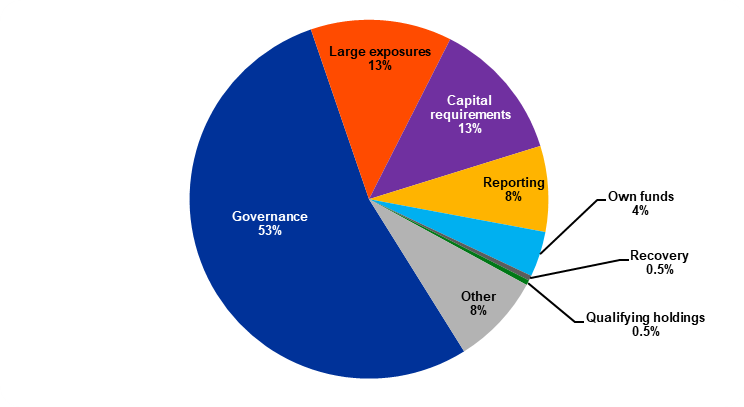
Within the area of governance, proceedings concluded with the imposition of a penalty related mainly to risk management and internal controls (66%), remuneration policies and committees (25%), organisational framework (10%) and fit and proper requirements (8%).
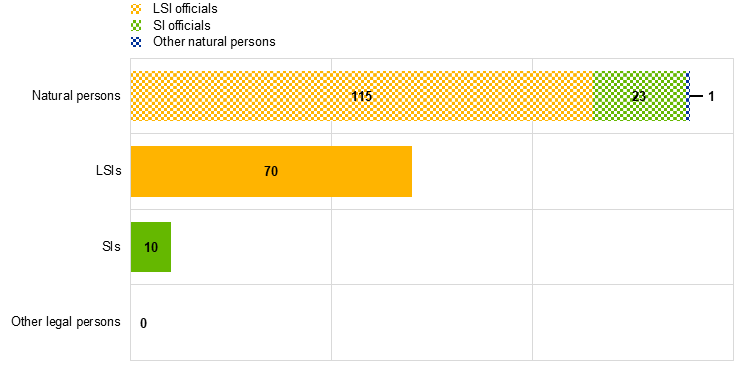
In terms of the type of person sanctioned, 139 (63%) of the 219 proceedings that led to an administrative penalty were related to natural persons, 70 (32%) to LSIs and 10 (6%) to SIs. Chart 7 presents a breakdown of all proceedings concluded with an administrative penalty in 2025 by type of person sanctioned.
Chart 7
Breakdown of proceedings concluded with an administrative penalty in 2025 by type of person sanctioned
Pecuniary penalties
Of the 152 administrative penalties that were imposed in 2025 for breaches of prudential requirements, 131 (86%) were pecuniary in nature, with fines totalling around €57.15 million. A total of 22 pecuniary penalties were imposed by NCAs in national proceedings opened at the ECB’s request pursuant to Article 18(5) of the SSM Regulation.
Two SIs faced the highest pecuniary penalties in proceedings opened by an NCA at the ECB’s request, which amounted to €15 million each. For other types of person, the highest pecuniary penalties were €7.67 million for an LSI and €0.2 million for a natural person.
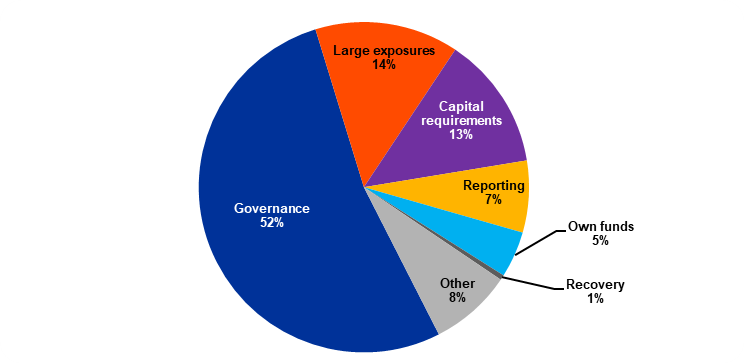
More than half of all pecuniary penalties were imposed in relation to breaches in the area of governance (52%), followed by large exposures (14%) and capital requirements (13%). Chart 8 provides a complete breakdown of all breaches subject to pecuniary penalties in 2025 by area of infringement.
Chart 8
Breakdown of pecuniary penalties imposed in 2025 by area of infringement
Other penalties
In addition to those pecuniary penalties, the SSM competent authorities also imposed 21 penalties of a non-pecuniary nature (which accounted for 14% of all administrative penalties imposed). These comprised 16 written warnings,[12] three temporary bans on performing functions in credit institutions and two public statements.
The non-pecuniary penalties were imposed on account of breaches relating to governance (62%), reporting (14%), capital requirements (9%), qualifying holdings (5%) and other (10%).
© European Central Bank, 2026
Postal address 60640 Frankfurt am Main, Germany
Telephone +49 69 1344 0
Website www.bankingsupervision.europa.eu
All rights reserved. Reproduction for educational and non-commercial purposes is permitted provided that the source is acknowledged.
The cut-off date for the data included in this report was 31 December 2025.
For specific terminology please refer to the SSM glossary (available in English only).
PDF ISBN 978-92-899-7858-3, ISSN 2600-4372, doi:10.2866/7926445 QB-01-26-128-EN-N
HTML ISBN 978-92-899-7857-6, ISSN 2600-4372, doi:10.2866/2000160 QB-01-26-128-EN-Q
The ECB can directly impose pecuniary penalties on significant institutions that breach directly applicable acts of EU law (including ECB decisions or regulations) in relation to which administrative pecuniary penalties shall be made available to competent authorities under the relevant EU law. It can also impose pecuniary penalties on less significant institutions for breaches of ECB regulations or decisions that impose obligations on those entities vis-à-vis the ECB. In case of breaches of national law implementing Union directives or breaches committed by natural persons, or when a non-pecuniary penalty has to be imposed, the ECB may require the relevant NCA to open national sanctioning proceedings pursuant to Article 18(5) of the SSM Regulation (Council Regulation (EU) No 1024/2013). The ECB may also address such a request to an NCA where national legislation confers specific sanctioning powers on the NCA which are not provided for by the relevant EU law. This does not affect an NCA’s ability to open proceedings on its own initiative under national law for tasks not conferred on the ECB.
The report does not cover sanctioning activities which fall outside the scope of prudential supervision within the SSM, such as activities relating to payment systems, markets for financial instruments, investment services, measures preventing the financial system from being used for money laundering or terrorist financing, and consumer protection.
The statistics presented in this report are calculated using data categories that differ from those applied by the competent authorities for supervisory disclosure under Article 143 of the Capital Requirements Directive (CRD; Directive 2013/36/EU). The scope of the sanctioning activities is also wider than that specified in Part 5 (“Data on supervisory measures and administrative penalties”) of Annex IV to Commission Implementing Regulation (EU) No 650/2014 laying down implementing technical standards on supervisory disclosure.
The respective supervisory roles and responsibilities of the ECB and the NCAs are allocated on the basis of the significance of the supervised entities. SIs are supervised entities (i.e. credit institutions, financial holding companies, mixed financial holding companies and branches established in participating Member States by credit institutions established in non-participating Member States) that are classified as “significant” on the basis of the criteria set out in Article 6(4) of the SSM Regulation and are supervised directly by the ECB. LSIs, by contrast, are subject to indirect supervision by the ECB – i.e. they are directly supervised by the NCAs, with the ECB providing oversight.
In this report, a “proceeding” is not the same as a “case”. If a case concerns multiple breaches, these are reported as different proceedings.
See the explanation in footnote 1. For the purposes of this report, a proceeding is considered to be “opened” when either (i) a formal act declaring the opening of the sanctioning proceedings is adopted by the relevant decision-making body of the competent authority before the persons concerned are formally granted the right to be heard for the first time on the facts established and the objections raised against them, or (ii) the persons concerned are formally granted the right to be heard for the first time on the facts established and the objections raised against them.
For the purposes of this report, “LSI official/SI official” is a member of the management body or key function holder of an LSI/SI falling within the scope of the SSM sanctioning activities.
In line with the composition of the SSM, where LSIs represent 69% of all supervised entities. In total, there were 2,648 supervised entities in 2025, with 112 supervised groups (comprising 820 individual entities) classified as “significant” as of 1 December 2025 and 1,828 entities classified as LSIs in the third quarter of 2025. For more detailed information, see the ECB Annual Report on supervisory activities 2025.
Proceedings being “closed” means that the proceedings were completed without the ECB or the relevant NCA imposing a penalty. This also includes (where applicable) ECB proceedings opened pursuant to Article 18(5) of the SSM Regulation which were ultimately closed without a request being addressed to the relevant NCA.
All of these proceedings had been suspended owing to criminal proceedings pending before national courts against the same person(s) in connection with the same facts.
Several proceedings may be addressed with one single penalty.
In some participating Member States, warnings are categorised differently under national law, being regarded not as a penalty, but as a supervisory or enforcement measure. The data presented in this report do not include such measures, since they are not adopted following formal sanctioning proceedings.