


Report on declared time commitment of non-executive directors in the SSM
1 Background
1.1 Time commitment of non-executive directors
All members of the management body must commit sufficient time to their functions in the supervised entity.
Non-executive directors are expected to commit sufficient time to their functions within the supervised entity.[1] In August 2019 the ECB published its first report on the declared time commitment of non-executive directors, to increase knowledge on their time allocation and to inform the assessments performed by both banks and supervisors. To this end, a benchmarking exercise was conducted and included in a report, which had a meaningful impact on governance standards in the supervised entities.
More specifically, the benchmarking exercise resulted in a better understanding of the factors affecting the time commitment required for a directorship (such as the nature of the directorship, size of the entity, number of committee memberships and synergies between different positions). By benchmarking the time committed by non-executive board members to their roles across supervised entities, the ECB can assess the adequacy of board engagement relative to the size, complexity and risk profile of each supervised entity. Benchmarking helps identify potential weaknesses in oversight, for example where board members may be overstretched owing to multiple positions held or insufficient involvement, thereby impacting the effectiveness of their supervision. This promotes stronger governance practices, encourages alignment with supervisory expectations – always based on proportionality – and fosters a level playing field across the Single Supervisory Mechanism (SSM).
Against this background, and six years on from the first exercise, the ECB decided to update the benchmarking data from 2019. The current benchmarking exercise is based on data collected by supervised entities and non-executive directors as part of the fit and proper assessments conducted from the first quarter of 2022 to the first quarter of 2025. The results indicate a significant increase in the average time commitment of non-executive directors to their positions as well as time committed per meeting, as well as a mild increase in their overall time commitment.
While this report provides valuable insights into the current situation regarding the declared time commitment of non-executive directors, it was established based on statements provided by entities that may not fully reflect the actual time committed by non-executive directors. It is a factual account of the ECB’s observations concerning the time commitment applied by supervised entities in practice. As such, this report imposes neither requirements nor supervisory expectations. It reflects varied market practices and its figures do not affect the principle of proportionality or the established risk-based and case-by-case assessment approach described in the Guide to fit and proper assessments. At the same time, the benchmarking should support both supervised banks in assessing the adequacy of their non-executive directors’ time commitment, and the supervisors in their aim for risk-based supervision, allowing for targeted reviews of material discrepancies.
As non-executive directors hold a supervisory function, they are expected to effectively oversee and monitor the management body’s decision-making, challenge the decisions of the management body in its management function and provide a counterbalance to the executive members.
Non-executive directors should participate in the meetings of the respective body and its committees, if applicable. They should also allocate sufficient time to preparing for and travelling to such meetings.
This is even more important in light of the rapidly changing environment, which demands well-informed non-executive boards that are able to adapt to the risks and opportunities that lie ahead. In addition, non-executive members are expected to allocate sufficient time to keeping up to date with relevant information concerning the supervised entity, and to set aside sufficient time for continuous learning and development. They also play a crucial role in ensuring that an adequate internal control and governance framework is in place, and they are expected to have an appropriate understanding of those areas of the business for which they are not individually responsible but are collectively accountable with the other members of the management body. This requires a sound knowledge of the entity’s governance arrangements and structure.
1.2 How the ECB assesses time commitment
Time commitment is subject to a case-by-case assessment of each application, taking the principle of proportionality into account.
In line with the Joint ESMA and EBA Guidelines on suitability[2], the ECB has developed specific policies for the assessment of time commitment, which are summarised in the Guide to fit and proper assessments. Time commitment is always subject to a case-by-case assessment of each application, taking the principle of proportionality into account.
1.2.1 Information to be provided by the supervised entity
In line with the Guide to fit and proper assessments, supervised entities should provide all relevant and necessary details to show that a non-executive director has sufficient time to commit to their position. In this regard, the ECB considers a minimum set of information from the supervised entity necessary to conduct the suitability assessment. This includes, inter alia, a full list of the appointee’s positions, the number of hours or days committed to each position, any additional responsibilities (such as membership of committees), the total number of meetings attended for each position, synergies between positions held allowing for a more efficient performance of duties, a self-declaration from the appointee that they have sufficient time to commit to all positions and a confirmation of adequate time provision for ongoing learning and buffers for periods of increased activity.
If it has concerns about time commitment, the ECB may request additional information from a supervised entity, taking individual circumstances into account and applying a proportionate approach.
1.2.2 Quantitative assessment of time commitment
The holding of multiple directorships is an important factor that may affect time commitment. The Capital Requirements Directive (CRD) therefore sets a limit on the number of directorships which may be held by a member of the management body in an institution that is “significant” in terms of its size, internal organisation and the nature, scope and complexity of its activities.[3] The number of directorships which can be held by a member of the management body of a significant institution under the CRD is limited to one executive directorship and two non-executive directorships, or four non-executive directorships. There are, however, exceptions to this rule: directorships in organisations which do not pursue predominantly commercial objectives do not count, and certain multiple directorships count as a single directorship (“privileged counting”).
However, in fit and proper assessments, the ECB does not only assess whether an appointee complies with these limits. Meeting solely the quantitative criterion set by the CRD, as transposed by national law, is not always sufficient. A high number of overall positions, even if compliant with the regulatory requirements, may constitute a supervisory concern and the ECB may seek additional information to ensure that the appointee will be able to cope with their overall commitment.
1.2.3 Qualitative assessment of time commitment
In addition to the quantitative limits on the number of directorships an appointee may hold, there are qualitative factors that determine the amount of time a director can commit to his/her function, such as (i) the size and circumstances of the entities where the directorships are held and the nature, scale and complexity of their activities; (ii) the location where the entities are based; (iii) other professional or personal commitments and circumstances (e.g. a court case in which the appointee is involved); (iv) the travel time required for the role; (v) the number of meetings scheduled for the management body; (vi) the time needed for necessary induction and training; and (vii) the nature of the specific position and the responsibilities of the member (e.g. chair or member of a committee), the appointee’s overall experience and their level of familiarity with the supervised entity. Supervised entities should also take into account the need for ongoing learning and development, as well as for a buffer for crisis situations or any other unexpected circumstances.
In order to assess whether an appointee commits sufficient time to his/her function, the ECB considers all relevant factors on a case-by-case basis. While the ECB expects appointees to commit sufficient time to performing their functions in the supervised entity, the amount of time deemed sufficient varies significantly depending on these factors. Furthermore, the ECB regularly conducts peer comparisons based on past and ongoing assessments of similar cases, which ensures a level playing field for all appointees and countries participating in the SSM.
For further details on the assessment of time commitment, please see Chapter 4.4 of the Guide to fit and proper assessments.
1.3 Recurring concerns regarding the time commitment of non-executive directors
In fit and proper assessments, the ECB regularly identifies concerns regarding the time commitment of non-executive directors. The most recurring concerns relate to:
- high number of positions;
- high overall time commitment;
- low time commitment to the role in the supervised entity.
In 2018 the ECB imposed conditions, obligations or recommendations in fit and proper decisions to address concerns about time commitment for around one out of every five assessed non-executive directors. The ECB has observed an overall positive trend in the time commitment declared by non-executive directors following the publication of the time commitment report in 2019. This is also reflected in the fact that ancillary provisions imposed in relation to time commitment made up less than 10% of all the ancillary provisions imposed in fit and proper decisions in 2024 and is further confirmed by the current benchmarking. Nevertheless, a non-negligible share of directors declares minimal engagement and the above-mentioned recurring issues persist, posing serious concerns regarding the effective functioning of many bank boards. Therefore, the ECB continues to treat the need to ensure adequate time commitment as a focal point in its fit and proper assessments.
2 Statistical analysis methodology
2.1 Data collection
The data used for this benchmarking exercise were collected by supervised entities and non-executive directors as part of the fit and proper assessment process conducted by the ECB from the first quarter of 2022 to the first quarter of 2025.
The sample of individual assessments (appointees) included in this latest benchmarking exercise amounted to 4,200, of which 461 referred to chair positions. As such, the sample was significantly broader than the one considered in the 2019 report (586 fit and proper assessments of non-executive directors, of which 63 concerned chair positions). The sample covered non-executive directors from all countries participating in the SSM and from 692 different entities, representing all 114 banking groups currently[4] directly supervised by the ECB (compared with 256 different entities from 74 of the 119 banking groups directly supervised by the ECB at the time of the 2019 report). The data covered non-executive directors in top entities as well as subsidiaries of banking groups. To ensure data accuracy, a randomised consistency check was performed. To construct each chart, the dataset was filtered based on the specific requirements of the chart to be created (by total assets, business model, etc.).
The data only represent factual information provided by supervised entities and non-executive directors as part of the fit and proper process. Consequently, incomplete or incorrectly completed fit and proper applications may influence the dataset utilised for the report. Results are presented on an aggregated level for the SSM as a whole and, where possible, are separated for regular non-executive directors and chairs owing to their different functions and levels of responsibility on the board.
2.2 Interpretation of the data
The data presented in this report are based on information provided by supervised entities and non-executive directors as part of fit and proper assessments and do not constitute an assessment by the ECB of the declared information.
The outcomes of the benchmarking exercise, therefore, do not provide an assessment of the sufficiency of any of the figures presented. They should, however, support supervised entities in fulfilling their primary responsibility of assessing the suitability of non-executive directors and the adequacy of their time commitment in line with the Joint ESMA and EBA Guidelines on suitability (paragraph 41(k)) and contribute to more robust suitability policies on time commitment within the supervised entities. Furthermore, the benchmarking should help supervised entities set expectations regarding time commitment for non-executive members of the management body.
3 Results
3.1 Declared time commitment for the function in the supervised entity
Across the SSM, non-executive directors declared on average that they committed 28 days per year to their function in the supervised entity. Non-executive chairs of the management body declared on average that they committed 64.2 days per year. Compared with the benchmarking exercise conducted by the ECB in 2019[5], the time commitment declared by non-executive directors increased by almost 6 days per year (from 22.2 days per year in 2019 to 28 days per year in 2025), while for chairs it increased by 15 days per year (from 41.6 days per year in 2019 to 56.9 days per year in 2025). These averages included several types of institution from different countries and non-executive directors with varying levels of responsibility. In general, the time non-executives allocated to their functions varied substantially. For non-executive directors, the time commitment varied from 10 to 60 days per year, while for chairs the declared time commitment varied from 15 to 200 days per year.
Chart 1
Time commitment declared by non-executive directors
(average, minimum and maximum of declared time commitment, in days per year)

Source: ECB Banking Supervision.
Chart 2
Time commitment declared by chairs
(average, minimum and maximum of declared time commitment, in days per year)

Source: ECB Banking Supervision.
3.1.1 Size of the supervised entity
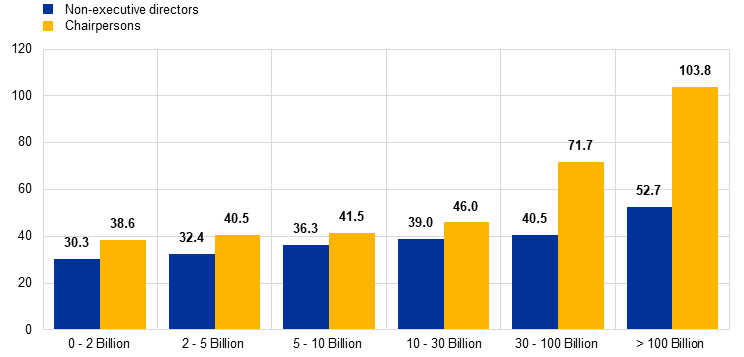
An important factor that influences the time commitment of non-executive directors is the size of the supervised entity. The results of this exercise show that size, expressed in total assets, is one of the main factors driving the level of time commitment. While the average time commitment in entities with total assets below €2 billion was 30.3 days per year for non-executive directors over the time period assessed, it was considerably higher in very large entities (52.7 days per year in entities with total assets above €100 billion). The differences are even more pronounced for chairs. In particular, chairs in very large entities committed a substantially higher amount of time to their functions compared with their counterparts in smaller entities.
Chart 3
Average time commitment declared by non-executive directors and chairpersons by size of the supervised entity
(x-axis: size of supervised entity in EUR billion of total assets; y-axis: average of declared time commitment in days per year)
Source: ECB Banking Supervision.
3.1.2 Membership of board committees
A further key factor which determines the time commitment of non-executive directors is their level of responsibility on the board. Non-executive directors with additional responsibilities, such as membership of one or several board committees, tend to commit more time to their functions. Membership of a board committee requires a non-executive director to attend additional meetings and to undertake specific work for the committee. This necessitates additional time for preparation, follow-up and keeping their specific knowledge up to date.
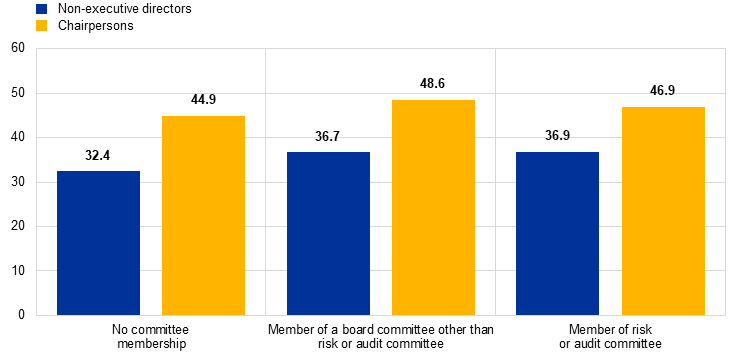
The difference between non-executive directors with and without membership of board committees is visible in the results of the benchmarking exercise. Based on the time commitment declared by non-executives, being a member of a board committee increases the time non-executive directors tend to commit. The same pattern can be seen among chairs of the board who are also members of board committees. From a more granular perspective, the specific type of board committee was observed to be of less importance in terms of the amount of time committed. Members of the risk or audit committee commit, on average, slightly more time than members of other board committees (e.g. nomination or remuneration committees).
Finally, with reference to the benchmarking exercise conducted by the ECB in 2019, the same trend in time commitment is observed, as non-executive directors and chairs tend to commit more time to their functions when participating in board committees.
Chart 4
Average time commitment declared by non-executive directors and chairpersons by membership of board committees
(average of declared time commitment in days per year)
Source: ECB Banking Supervision.
3.1.3 Business model of the group
The time commitment of non-executive directors is also dependent on the entity’s business model. With reference to the benchmarking exercise conducted by the ECB in 2019, a similar trend in time commitment can be observed: more complex business models usually require more time from non-executive directors. This assumption is confirmed by the data. The chart further highlights a noticeable increase in time commitment across all business models when compared with the 2019 data. The statistics presented in Chart 5 only show the time commitment of non-executive directors in top entities. Non-executive directors in top entities of complex and large banking groups, such as G-SIBs or large diversified lenders, committed more time to their functions than non-executive directors in entities with more specific business models, such as consumer credit lenders. The categorisation of business models has been updated since the 2019 benchmarking exercise and is now aligned with the SSM’s current classification of different business models.
Data for chairs are not included owing to the small sample size of chairs in top entities.
Chart 5
Average time commitment declared by non-executive directors in top entities by business model of the group
(average of declared time commitment in days per year)

Source: ECB Banking Supervision.
3.1.4 Time commitment in relation to number of board meetings
The time needed to prepare for (including travelling time, as relevant) and attend board meetings takes up a significant portion of the time that non-executive directors need to fulfil their duties in a supervised entity. Accordingly, the ratio of declared time commitment to number of board meetings is an important factor when assessing if the time commitment of a non-executive director is sufficient. At the same time, a low number of board meetings per year may not justify per se a low time commitment. Sufficient time commitment is not solely linked to the number of meetings, but is understood as allowing non-executive directors sufficient time to perform all their functions in the institution as described above, including adequate time for ongoing learning and buffers for periods of increased activity.
Looking at the ratio of days committed per year to the number of board meetings per year, non-executive directors were shown to commit 3.9 days on average per year/board meeting. Chairs committed 4.6 days on average per year/board meeting. In terms of time commitment, the ratio of days per year/board meeting differed greatly among non-executive directors, ranging from 2.0 to 34 days per year/board meeting.
In comparison with 2019, there has been a general increase in the number of days that both chairs and non-executive directors commit per board meeting. For non-executive directors, the average grew by 1.1 days per year (3.9 in 2025 compared with 2.8 in 2019). For chairs, the average was also higher by 1.1 days per year (4.6 in 2025 compared with 3.5 in 2019).
Chart 6
Ratio of time commitment declared by non-executive directors and number of board meetings
(average, minimum and maximum of declared time commitment, in days per year/board meeting)

Source: ECB Banking Supervision.
Chart 7
Ratio of time commitment declared by chairpersons and number of board meetings
(average, minimum and maximum of declared time commitment, in days per year/board meeting)

Source: ECB Banking Supervision.
3.2 Number of directorships
While non-executive directors have to comply with the limits on the number of directorships they can hold under the CRD,[6] they can hold more directorships if these are subject to privileged counting or to no counting rules.[7]
Separately from the counting perspective, the benchmarking exercise looked at how many directorships non-executive directors and chairs held in total, taking all directorships into account, including those within the same group and in predominantly non-commercial organisations. The total number of directorships is an important factor for the qualitative assessment of time commitment, as each directorship requires time and attention whether it is counted or not.
Comparison with 2019 shows a slight increase in the number of directorships held by non-executive directors (increase of 0.1, from 3.9 in 2019 to 4 in 2025) and chairs (increase of 0.2, from 4.4 in 2019 to 4.6 in 2025).
The results show that a large majority of non-executive directors and chairs held only a small number of directorships. More than 80% of all non-executive directors and almost 80% of chairs held between one and five directorships. Only a smaller portion held a higher or very high number of directorships. In the observed sample, non-executive directors and chairs held four directorships on average; 4.2% of non-executive directors held between 11 and 15 directorships and 1.3% even held more than 15.
Chart 8
Number of directorships held by non-executive directors
(average, minimum and maximum of total number of directorships (executive and non-executive) held including directorships within the same group and/or in predominantly non-commercial organisations)

Source: ECB Banking Supervision.
Chart 9
Number of directorships held by chairpersons
(average, minimum and maximum of total number of directorships (executive and non-executive) held including directorships within the same group and/or in predominantly non-commercial organisations)

Source: ECB Banking Supervision.
Chart 10
Percentage of non-executive directors and chairpersons holding different numbers of directorships
(directorships (executive and non-executive) held, including directorships within the same group and/or in predominantly non-commercial organisations)

Source: ECB Banking Supervision.
3.3 Overall time commitment declared for all directorships
Another factor that is taken into account when assessing time commitment in fit and proper assessments is the overall total time committed by non-executive directors. The results of the benchmarking exercise show that non-executive directors declared on average a commitment of 195.5 days per year to all of their positions (199.7 for chairpersons). As with the time commitment to their specific function in the supervised entity, the total time commitment for all directorships varied greatly among directors.
Comparison with 2019 shows an increase in the overall time commitment of non-executive directors (increase of 22.5 days per year, from 173 in 2019 to 195.5 in 2025) and chairs (increase of 7.7 days per year, from 192 in 2019 to 199.7 in 2025).
Chart 11
Total time commitment declared by non-executive directors for all directorships held
(average, minimum and maximum of total declared time commitment, in days per year)

Source: ECB Banking Supervision.
Chart 12
Total time commitment declared by chairpersons for all directorships held
(average, minimum and maximum of total declared time commitment, in days per year)

Source: ECB Banking Supervision.
4 Conclusion
Non-executive directors are expected to provide robust oversight – approving and overseeing the implementation of the bank’s strategic objectives, challenging management decisions, overseeing internal controls and understanding the bank’s business and risk profile. Without adequate time commitment, their effectiveness is compromised. To safeguard strong governance standards, the time committed by non-executive directors to their positions remains a key focus of the ECB’s fit and proper assessments.
Against this background, time commitment is subject to a case-by-case assessment of each application, taking into account the principle of proportionality. In fit and proper assessments, the ECB always considers all relevant factors, such as the size of the entity, the nature, scale and complexity of its activities, the nature of the specific position and the responsibilities of the non-executive director.
To support its fit and proper assessments, the ECB regularly conducts peer comparisons based on past and ongoing assessments of similar cases, which ensures a level playing field for all appointees and countries participating in the SSM. To this end, the ECB has updated its 2019 benchmarking data on the declared time commitment of non-executive directors and chairs, as presented in this report. This should further support banks in fulfilling their primary responsibility of assessing the suitability of non-executive directors. These findings inform – but do not dictate – the ECB’s supervisory expectations, which remain grounded in individualised assessment and proportionality.
The ECB will continue to follow up on the time commitment of non-executive directors in fit and proper assessments and in ongoing governance supervision. It will also continue its dialogue with banks on the role of non-executive directors and the importance of ensuring adequate time commitment by non-executive directors.
© European Central Bank, 2026
Postal address 60640 Frankfurt am Main, Germany
Telephone +49 69 1344 0
Website www.bankingsupervision.europa.eu
All rights reserved. Reproduction for educational and non-commercial purposes is permitted provided that the source is acknowledged.
For specific terminology please refer to the SSM glossary (available in English only).
Article 91(2) of Directive 2013/36/EU of the European Parliament and of the Council of 26 June 2013 on access to the activity of credit institutions and the prudential supervision of credit institutions and investment firms (the Capital Requirements Directive), (OJ L 176, 27.6.2013, p. 338).
Joint ESMA and EBA guidelines on the assessment of the suitability of members of the management body and key function holders (EBA/GL/2021/06).
Article 91(3) of the CRD.
As at 2025.
ECB (2019), Report on declared time commitment of non-executive directors in the SSM, August.
Article 91(3) of the CRD.
For further details see Guide to fit and proper assessments.