



- CONTRIBUTION
Banks and competitiveness: promoting competition, protecting resilience
Contribution by Claudia Buch, Chair of the Supervisory Board of the ECB, prepared for Forum on Financial Supervision (LSE)[1]
23 February 2026
Promoting competitiveness and growth has become a central theme in policy debates.[2] In recent decades, labour productivity growth has been lower in the countries of the European Union than in other major economies.[3] Demographic change has been a structural headwind; innovation dynamics have been weak; and external shocks and global trade uncertainty have taken their toll. In terms of policy responses, deeper European integration and policies to promote innovation are widely seen as key.
As the debate has turned to the role of banks in promoting competitiveness and growth, this blog provides a banking supervision perspective. It argues that strong regulation and supervision contribute to the resilience of banks’ business models and their ability to service the economy. The banking union’s strong institutions underpin trust in European banking markets. All of these are factors that strengthen the competitiveness of banks.
The reforms put in place after the financial crisis have contributed to more resilient and better-capitalised banks. This has enabled banks to lend to the economy and to maintain their important role in financing European corporates. At the same time, the effects of heightened geopolitical uncertainty are leaving their mark on credit markets. Uncertainty can lead banks to tighten their lending standards to account for higher risks, and it can weaken the demand for credit.[4]
When it comes to financing innovation and long-term investments in infrastructure or the climate transition, equity and venture capital are important complements to bank lending. In this respect, progress on the capital markets union remains essential.[5]
At the same time, streamlining banking regulation and supervision can support banks’ ability to respond to a fast-changing external environment, to heightened geopolitical risks and the digitalisation of financial services. The Governing Council of the European Central Bank (ECB) has thus recently presented the European Commission with recommendations on how to simplify the legislative framework applying to banking regulation, supervision and reporting.[6] In parallel, the ECB’s Supervisory Board has a dedicated reform agenda to streamline supervision, to make it more efficient, effective and risk-based, which is summarised in a recent report.[7]
These two reports define clear red lines: any simplification must maintain current levels of resilience and remain fully consistent with international prudential standards.
Beyond the simplification of regulation and supervision, a focus on four policy priorities can enable the banking sector to continue playing its role in promoting growth and stability.
First, a global level playing field is essential so that banks compete on efficiency, innovation and sound risk management. This entails upholding agreed standards and addressing evolving risks to financial stability.
Second, promoting the cross-border provision of financial services can strengthen integration and competition in Europe. A deeper and more integrated Single Market can foster the efficiency and competitiveness of banks.
Third, strong capital standards underpin banks’ resilience and competitiveness. Sound capitalisation enables banks to respond to evolving risks and to more intense competition without taking undue risks. It enables banks to service the economy also in times of stress and to invest in their long-term business models. Resilience and competitiveness go hand in hand.
Fourth, with the banking union, Europe has strong institutions which safeguard the safety and soundness of banks. This ensures that banking markets can adjust to a changing environment – including through the entry of new firms and, if needed, the orderly exit or resolution of weak banks – without putting financial stability at risk. Completing the banking union by establishing the European deposit insurance scheme (EDIS) should thus be a priority to improve crisis management and further reduce the bank-sovereign nexus.
The global perspective: levelling the playing field between banking systems
One of the drivers behind the debate on competitiveness has been differences across jurisdictions globally in the timing, scope and national implementation of international banking standards. This debate should, however, take into account that competition takes place between individual institutions operating in specific markets, not between entire “systems”. A banking system is composed of different banks that have very different business models and compete on different markets. But all banks have one thing in common: they benefit from a level playing field across markets.
At the same time, the institutional framework applying to a banking system determines the attractiveness of a marketplace. It shapes the rule of law, the credibility of public institutions and the procedures that apply, and it matters for the trust that savers and investors have in the system. With the banking union, Europe has made significant progress; the improved resilience and valuations of European banks are a clear indication that markets have gained greater trust in European banks and the institutional framework.[8]
Rather than marketplaces “competing” against each other through standard-setting, rules applying to banking activities need to be broadly aligned globally. Levelling the international playing field is the essence of the work done by the Basel Committee (BCBS) and the Financial Stability Board (FSB), with their global membership. This is why we remain strongly committed to international cooperation and work to address evolving financial stability risks. Some of these risks lie outside of the banking sector, and they require further progress towards a strong, coordinated international policy response. Both the BCBS and the FSB have also developed frameworks that allow using the best available evidence to understand relevant trade-offs, effects and side effects of regularity choices.[9]
The minimum harmonisation of global banking rules does not mean that rules applying to banks on national markets must be identical. Within the set of global rules that level the playing field, sovereign states can still make choices about how banks are regulated and supervised to address national specificities, risks, and risk tolerance levels. But as closely interwoven as banking systems are, and as easily as shocks can spill over internationally, policymakers have a shared responsibility to uphold common minimum standards.
There is always the temptation to relax banking rules to promote short-term growth, bank lending and profitability. But unless the root causes of weak growth are tackled, the main effect of weaker rules may be higher payouts rather than a sustained expansion of lending. Lower standards could even weaken banks’ incentives to compete on efficiency, innovation and sound risk management. At the global level, it could lead to retaliation and a lowering of standards overall.[10]
Weaker regulation or supervision would increase risks to financial stability – with negative long-run effects for the real economy, trust in the financial system and, ultimately, public finances. It should not be forgotten that, during past banking crises, fiscal costs were sizeable, output losses were large and sustained, and unemployment increased by more than during normal recessions.[11]
The bank-level perspective: what drives competitiveness?
Competitiveness is defined in a more meaningful way in relation to the performance of individual banks – their productivity, efficiency, profitability, and ability to innovate and provide services of better quality or at lower costs than others. Reliable rules and a level playing field, in turn, are important factors shaping the performance of banks.
Understanding the drivers of competitiveness thus requires zooming in on individual banks. Banks differ in their business models, productivity and cost structures, which place them in a stronger or weaker position than their peers serving the same product market or region.
Profitability is one indicator of the strength of a bank’s business model. Evidence clearly shows that higher profitability goes hand in hand with lower cost-to-income ratios (higher efficiency), lower levels of non-performing loans (lower risk) and higher capital ratios.[12]
International differences in bank profitability often reflect structural differences in the competitive structure, size, and depth of markets. In comparison to their US peers, for example, European banks tend to operate at a smaller scale and with more limited network effects.[13] In particular, during the early post-crisis period, elevated levels of non-performing loans weighed on European banks’ balance sheets and earnings. Moreover, US banks tend to invest more in IT, which raises costs but also supports operational capabilities and the provision of digital services.
At the same time, profitability and competitiveness are not the same.[14] High profitability may reflect superior efficiency and stronger business models – but it can also be a sign of an insufficient degree of competition or excessive, short-term risk taking. Moreover, key drivers of profitability are of a macroeconomic nature and thus lie beyond the individual bank’s control. The recent increase in European banks’ return on equity, for example, has been strongly correlated with the upward shift in overall interest rates.[15]
Studies have thus looked more directly at measures of banks’ profit efficiency, often defined as a bank’s ability to produce the maximum output given its inputs. These studies show that efficiency is driven by a number of bank-level and country-level characteristics.[16] Larger banks and banks with a higher quality of assets tend to be more efficient. At the country level, strong economic growth and industrial production are positively correlated with bank efficiency.
One interesting result is that bank efficiency is not strongly correlated with capitalisation overall.[17] Rather, this relationship is non-linear – over the relevant range of capitalisation observed for European banks, efficiency increases; beyond that, it tends to decline.
This evidence puts the debate around bank capital and competitiveness into perspective. Banks may consider capital to be more expensive than debt, due to factors such as differences in tax treatment or implicit funding subsidies.[18] It is thus sometimes argued that higher capital requirements could put banks at a competitive disadvantage and constrain their ability to service the real economy.
But these claims are not supported by the available evidence. Capital is a stable source of funding for banks, not a reserve that banks need to set aside and cannot lend out. Capital is particularly valuable at present as banks need to invest in their IT infrastructure to remain competitive vis-à-vis non-bank providers of digital financial services. Capital is a funding source that has the added advantage of absorbing losses if risks materialise – with positive implications for financial stability. Moreover, once differences in risk over the cycle are taken into account, it is not even clear that capital is systematically a more expensive source of funding than debt.[19]
Finally, better capitalised banks can lend more rather than less, particularly in the long term and during periods of stress.[20] The time horizon matters here: increasing capital requirements at a time when banks are undercapitalised can lead to a reduction in lending. Many studies of banks’ adjustment to higher capital requirements after the great financial crisis have captured this effect. In particular in the longer term, the positive implications of bank capital clearly prevail. Good capitalisation therefore enables banks to better respond to a changing risk environment and more intense competition.
In sum, competitiveness starts at the bank level. How efficient, productive and competitive banks are depends on the resilience of their business model, their governance and risk controls. Supervisors focus on these aspects when monitoring the banks’ safety and soundness. In this sense, banks’ resilience and their competitiveness go hand in hand.
The European market perspective: competition at the national level and across borders
Banks’ competitiveness is affected by the market in which they operate and the rules that apply to them. Promoting competition can thus incentivise banks to become more efficient, to innovate and to strengthen their business models.[21]
Competition refers to the structure and contestability of markets – how many firms operate in a given market, how concentrated markets are, how easy it is to enter and exit markets and how integrated markets are across borders.
In Europe, there is scope to strengthen competition, particularly across borders. Despite harmonised banking regulations and the Single Rule Book, important rules relevant for banks differ across countries. National legal systems differ on rules around corporate governance, insolvency legislation or the mortgage market. Greater harmonisation could thus support simplification and, at the same time, promote the Single Market.
Indicators of competition in European banking markets paint a nuanced picture and show areas where competition could be enhanced.
First, despite successive rounds of harmonising banking rules in Europe, cross-border competition remains limited; the Single Market for banking services remains fragmented.[22] Around 80% of banks’ loan portfolios are invested at the national level.[23] In several euro area countries, the share of foreign affiliates in banking assets has in some cases even declined since the global financial crisis (Chart 1). Cross-border merger activity, an important catalyst for integration, has declined (Chart 2).
Chart 1: Share of foreign-controlled branches’ and subsidiaries’ assets in total assets
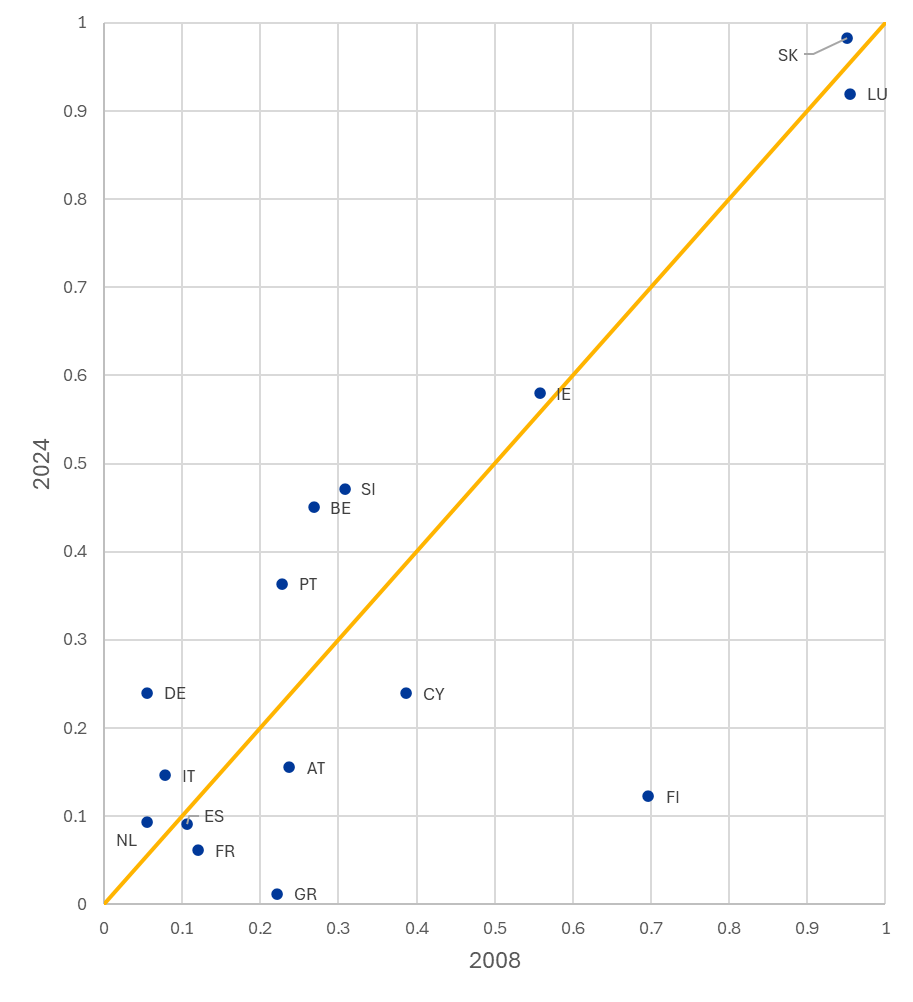
Sources: ECB calculations based on banking structural statistical indicators and balance sheet items statistics.
Note: Total assets of foreign-controlled branches and foreign-controlled subsidiaries of credit institutions countries as a share of total assets of all deposit-taking corporations excluding national central banks
Chart 2: Domestic and cross-border bank mergers in the euro area
(1999-2025, EUR billions and number of deals)
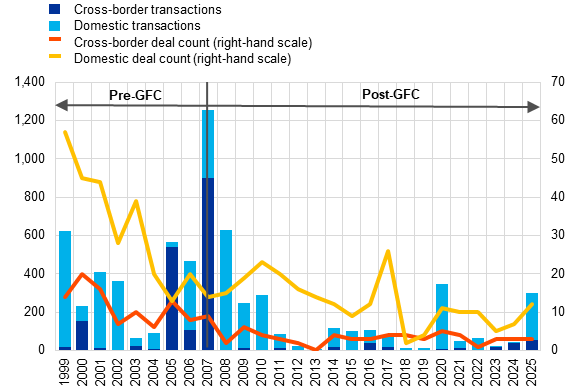
Sources: Dealogic, BvD Electronic Publishing GmbH – a Moody’s Analytics company, ECB (supervisory data) and ECB calculations.
Notes: Relevant M&A transactions exclude the acquisition of assets, repurchases, privatisations, leveraged buyouts, joint ventures and restructurings. They meet the following criteria: (1) the acquired stake is above 10%, corresponding to a qualifying holding; (2) the initial stake is below or equal to 50%; and (3) the final stake is above 50%. In cases where multiple banks are involved in a deal as target and/or acquirer, at least one of the targets and/or acquirers have to be domiciled within the euro area. The transactions are reported by the year in which they were announced. The periods before and after the global financial crisis (GFC) are defined as 1999-2007 and 2008-2025 respectively.
Second, competition differs in intensity across countries and these differences have been quite persistent over time.[24] In some Member States, a small number of large banks dominate the market, while other markets are less concentrated. The share of assets held by the five largest banks has risen in many European countries over the past two decades, pointing to higher market concentration (Chart 3).
Chart 3: Share of the 5 largest banks in total assets
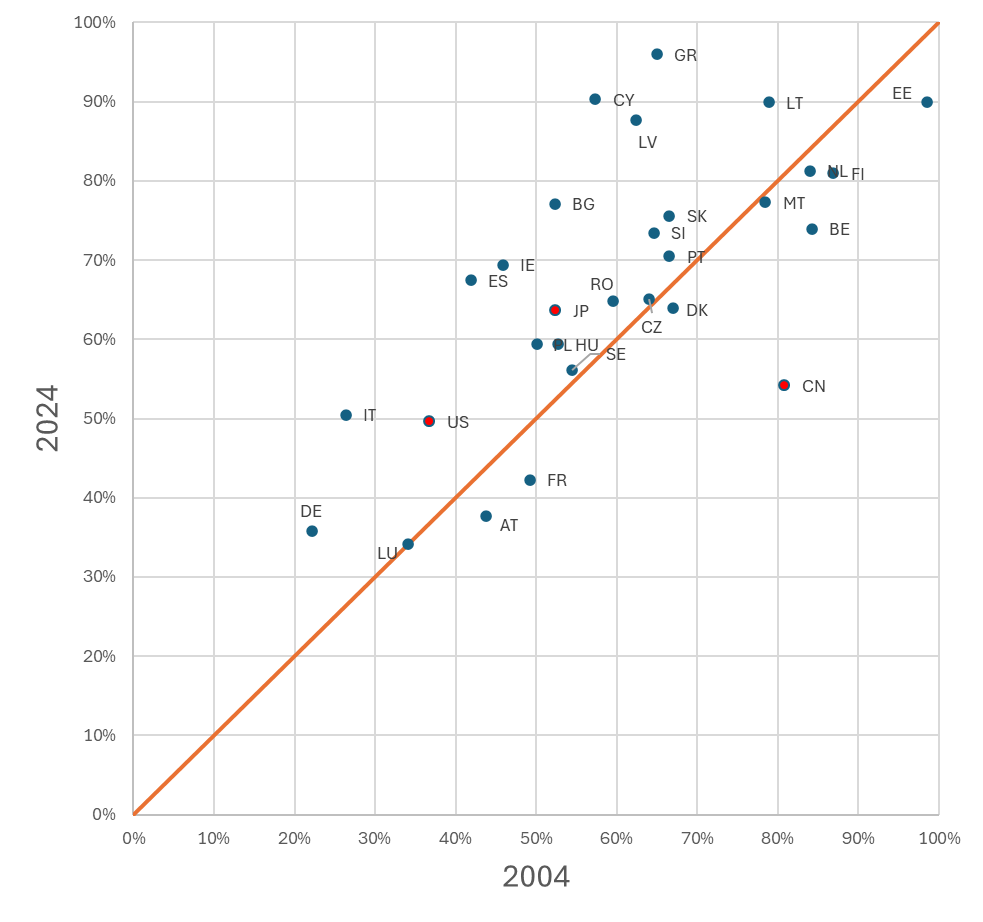
Sources: ECB banking structural statistical indicators and World Bank global financial development database.
Notes: Data for the United States, China and Japan are for 2021, all other countries are 2024.
Third, the pricing power of European banks – measured by their ability to price services above marginal costs – has strengthened, as have risk indicators (Chart 4). That said, trends in market power depend on how it is measured.[25] Moreover, pricing power is unevenly distributed across banks, and it tends to be higher for the larger banks.[26]
Chart 4: Market power and risk of euro area banks
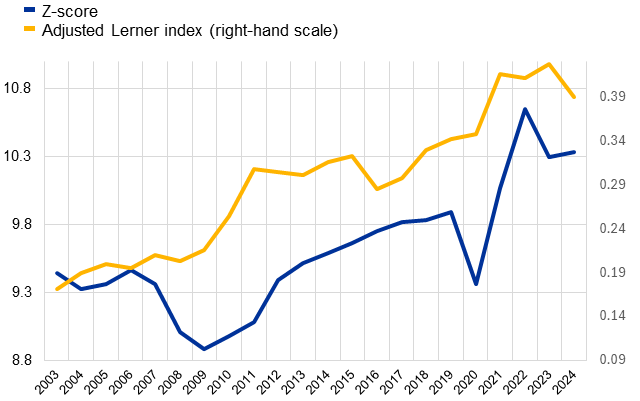
Sources: BankFocus and ECB calculations.
Notes: Based on a sample of 3,703 euro area banks. The adjusted Lerner index is measured as the difference between prices (interest income and fees and commissions income scaled by total assets) and marginal cost (measured as a function of labour, fixed and funding costs) expressed as a ratio of prices. It ranges between 0 and 1, where higher values are associated with stronger market power and reflect weaker competition. The index is adjusted for inefficiency, time trends and credit risk. The Z-score is in logarithm and measures a bank’s distance to default. It is defined as the sum of the return on assets and the equity-to-total assets ratio over the standard deviation of the return on assets (measured on a three-year rolling window). Higher values indicate more stability.
Fourth, banks’ exposure to international competition is uneven.[27] Some large European banks are directly exposed to international competition through investment banking and capital markets activities for example. In core retail and commercial banking, by contrast, competition often remains predominantly domestic, with lending to households and small and medium-sized enterprises and deposit-taking still largely concentrated in national banks.
The digitalisation of financial services could be a catalyst for more intense competition while enhancing the contestability of banking markets. Providers of digital financial services are increasingly entering the arena, blurring the traditional role of national borders in shaping – and often fragmenting – economic relationships. In response, banks need to develop sustainable digital business models. They have to deal with a larger number and different types of competitors than before, including in core activities such as payments markets.
Taken together, these indicators show room for strengthening competition in Europe. Market structures have remained rather persistent over time and concentration has often increased. Many incumbents have considerable market power and there is still limited cross-border integration.[28] This lack of integration can impair banks’ ability to scale up.[29]
Policy priorities to promote the Single Market and resilience
Looking ahead, promoting the integration of the Single Market while safeguarding resilience should be a priority. A lack of competition can protect unsustainable business models. Better integrated markets and a higher degree of cross-border competition would allow banks to better reap economies of scale and diversify their activities. This can strengthen both their competitiveness and their resilience.
To promote the Single Market, policymakers can further remove undue frictions and complexities in the regulatory framework that prevent market integration. The ECB’s High Level Task Force on Simplification has put forward proposals on how to simplify capital stacks, strengthen proportionality, streamline stress testing, reduce fragmentation and cut duplicative reporting requirements – all while preserving resilience and international consistency. ECB Banking Supervision is implementing an extensive reform agenda to increase efficiency, effectiveness and risk focus.
Focusing on relevant risks and safeguarding resilience should indeed be the second policy priority. Increased competition can lead to more risk-taking. There is a long-running debate on whether a “competition-stability” or a “competition-fragility” nexus prevails.[30] More intense competition can spur innovation and efficiency gains; but it can also compress margins and franchise values, creating incentives to search for yield, loosen lending standards or underinvest in resilience.
Guardrails are needed to ensure that banks do not respond to more intense competition by taking undue risks that might threaten their soundness and financial stability. Strong supervision and credible resolution regimes can turn the benefits of more intense competition into lasting improvements in welfare. Both need a reliable regulatory framework that upholds strong standards.
With the banking union, Europe has strong institutions which promote healthy competition by ensuring that banks remain safe and sound, that banks with new and innovative business models can enter the market, and that those which cannot compete successfully can exit the market without putting financial stability at risk. In this way, supervision and resolution frameworks support resilient business models and sustain investor confidence.
But further steps are needed. An essential element in completing the banking union is European deposit insurance: it would promote integration, strengthen crisis management and further weaken the bank-sovereign nexus.
It is this route, not weaker standards, that will lead to healthy competition and sustainable growth while maintaining financial stability. Any policy choices that are made to further improve the framework should be based on the best available evidence, taking a holistic perspective that promotes growth and protects resilience.[31]
I am grateful to Stephanie Czák-Ludwig, Sara Frost, Tanja Derin, Sharon Donnery, Korbinian Ibel, Daniel Legran, Conny Lotze, Samuel McPhilemy, Patrick Montagner, Sebastien Perez Duarte, Mario Quagliariello, Alessio Reghezza, Antonio Riso, John Roche, Kallol Sen, Anneli Tuominen and Florian Weidenholzer for their comments and support in preparing this speech. Any errors and inaccuracies are my own.
Draghi, M. (2024), The future of European competitiveness – A competitiveness strategy for Europe, European Commission, 9 September.
IMF (2025), “Overcoming Europe’s Policy Drift: From Recognition to Action”, Regional Economic Outlook for Europe, October; OECD (2025), OECD Economic Surveys: European Union and Euro Area 2025, 3 July; Lopez-Garcia, B. and Szörfi, B. (2021), “Key factors behind productivity trends in euro area countries”, Economic Bulletin, Issue 7, ECB; Battistini, N., Bobasu, A. and Gareis, J. (2023), “Who foots the bill? The uneven impact of the recent energy price shock”, Economic Bulletin, Issue 2, ECB; Avril, P. Bochmann, P., Fahr, S., Horan, A., Pancaro, C. and Pizzeghello, R. (2025), “Risks to euro area financial stability from trade tensions”, Financial Stability Review, May.
Recent ECB analysis suggests that the current weakness in credit dynamics compared with past recoveries affect lending by banks and non-banks alike and is linked to broader cyclical and structural factors. Di Casola, P., Mendicino, C., Nicoletti, G. and Skoblar, A. (2026), “Mind the gap: credit dynamics in the euro area”, The ECB Blog, 26 January.
ECB (2024), Statement by the ECB Governing Council on advancing the Capital Markets Union, 7 March; Federal Ministry of Finance (2026), Financing Innovative Ventures in Europe, January.
ECB (2025), Simplification of the European prudential regulatory, supervisory and reporting framework.
See Chart 3.4 in ECB (2025), Financial Stability Review, November.
Basel Committee on Banking Supervision (2022), Evaluation of the impact and efficacy of the Basel III, Bank for International Settlements, December. Financial Stability Board, (2017), Framework for Post-Implementation Evaluation of the Effects of the G20 Financial Regulatory Reforms, July.
Buchholz, M., Loeffler, A. and Sigel, P. (2025), “Do capital requirements and their international differences affect banks‘ profitability?”, Discussion Paper, No 31, Deutsche Bundesbank; the authors simulate a race to the bottom of capital standards and find negative implications for bank profitability.
Laeven, L. and Valencia, F. (2018), “Systemic Banking Crises Revisited”, Working Paper, IMF, September.
Molyneux, P., Reghezza, A. and Xie, R. (2019), “Bank margins and profits in a world of negative rates”, Journal of Banking and Finance, Vol. 107, No 105613.
Di Vito, L., Martín Fuentes, N. and Matos Leite, J. (2023), “Understanding the profitability gap between euro area and US global systemically important banks”, Occasional Paper Series, No 327, ECB.
For a discussion on competitiveness and its measurement in the literature see Behn, M. and Reghezza, A. (2025), “Capital requirements: A pillar or a burden for bank competitiveness”, Occasional Paper Series, No 376, ECB, October.
The average return on equity across significant institutions currently stands at around 10% and thus 4.5 percentage points above the levels observed during the period of low interest rates, 2015-22. The latest information is available for the second quarter of 2025, with an average of 9.9% across the previous four quarters.
See the literature reviewed in Buchholz, M. et al., op. cit., or Behn, M. and Reghezza, A., op. cit.
See Behn, M. and Reghezza, A., op. cit. Similarly, Buchholz, M. et al. find no negative implications of higher capital requirements on bank profitability.
Admati, A. and Hellwig, M. (2004), “The Parade of the Bankers’ New Clothes Continues: 44 Flawed Claims Debunked”, ECGI Working Paper Series in Finance, No 951, European Corporate Governance Institute, 4 January.
Belkhir, M., Chami, R. and Semet, A. (2019), "Bank Capital and the Cost of Equity", IMF Working Papers, No 265; Miles, D., Yang, J. and Marcheggiano, G. (2013), “Optimal Bank Capital”, The Economic Journal, Vol. 123, No 567, 1 March, pp. 1-37; Baker, M. and Wurgler, J. (2015), "Do Strict Capital Requirements Raise the Cost of Capital? Bank Regulation, Capital Structure, and the Low-Risk Anomaly", American Economic Review, Vol. 105, No 5, pp. 315-20, May.
For recent studies on the link between capital and lending as well as reviews of the literature, see Buchholz, M., Loeffler, A. and Sigel, P. (2025), op. cit.; Budrys, Z., Cappelletti, G., Ponte Marques, A., Peeters, J. and Varraso, P. (2019), “Impact of higher capital buffers on banks’ lending and risk-taking: evidence from the euro area experiments“, Working Paper Series, No 2292, ECB, Frankfurt am Main, June; Kapan, T. and Minoiu, C. (2013) “Balance Sheet Strength and Bank Lending During the Global Financial Crisis”, IMF Working Paper, No 102, International Monetary Fund, Washington DC, 8 May. The Financial Regulation Assessment: Meta Exercise (FRAME) contains studies on the effects of capital and liquidity regulation as well as the too-big-to-fail reforms. See Boissay, F., Cantú, C., Claessens, S. and Villegas, A. (2019), “Impact of financial regulations: insights from an online repository of studies”, BIS Quarterly Review, Bank for International Settlements, 5 March; Buch, C. and Prieto, E. (2014), “Do Better Capitalized Banks Lend Less? Long-Run Panel Evidence from Germany”, International Finance, Vol. 17, No 1, Spring.
See de Bondt, G. J., Huljak, I. and van Leuvensteijn, M. (2024)’, “A new measure of firm-level competition: an application to euro area banks”, Working Paper Series, No 2925, ECB, Frankfurt am Main, 12 April. The authors develop a measure of competition at firm level based on marginal relative profitability and document that many banks may not be sufficiently incentivised to increase their efficiency because they are largely insulated from the competitive power of their peers.
See International Monetary Fund (2024), Regional Economic Outlook, October; Bernasconi, R., Cordemans, N., Gunnella, V., Pongetti, G. and Quaglietti, L. (2025), “What is the untapped potential of the EU Single Market?”, Economic Bulletin, Issue 8, ECB.
See Coccorese, P., Girardone, C. and Shaffer, S. (2021), “What affects bank market power in the euro area? A country-level structural model approach”, Journal of International Money and Finance, Vol. 117, No 102443, October, for evidence of banks’ market power, heterogeneity across countries and trends over time.
ibid.
ibid.
ECB (2024), Financial Integration and Structure in the Euro Area, June.
See Cavalleri, M. C., Eliet, A., McAdam, P., Petroulakis, P., Soares, A. and Vansteenkiste, I. (2019), “Concentration, market power and dynamism in the euro area”, Working Paper Series, No 2253, ECB, Frankfurt am Main, 25 March.
For evidence showing that European banks operate at an inefficient scale, see Andreeva, D., Grodzicki, M., More, C. and Reghezza. A. (2019), “Euro area bank profitability: where can consolidation help?”, Financial Stability Review, ECB, Frankfurt am Main, November.
For a comprehensive review of the literature and the relevant trade-offs, see OECD (2025), “Balancing prudential regulation and competition considerations in banking”, OECD Roundtables on Competition Policy Papers, No 329, OECD Publishing, Paris. For a historical analysis of the link between the competitive structure of banking systems and their fragility, see Calomiris, C.W. and Haber, S. (2014), Fragile by Design: The Political Origins of Banking Crises and Scarce Credit, Princeton University Press. A recent study by Ferreira, C. (2023), “Competition and Stability in the European Union Banking Sector”, International Advanced Economic Research, Vol. 29, pp. 207-224, finds support for the competition-fragility hypothesis for the EU overall, but also differences across countries.
European Commission (2026) “Targeted consultation on the competitiveness of the EU banking sector”, 11 February
Europos Centrinis Bankas
Komunikacijos generalinis direktoratas
- Sonnemannstrasse 20
- 60314 Frankfurtas prie Maino, Vokietija
- +49 69 1344 7455
- media@ecb.europa.eu
Leidžiama perspausdinti, jei nurodomas šaltinis.
Kontaktai žiniasklaidai