


- SUPERVISION NEWSLETTER
A risk-based approach to assess NPLs
11 February 2026
Authors: Luis Carvalho, Daniele Frison
Over the past decade, banks directly supervised by the ECB have made considerable progress in reducing non-performing loans (NPLs) on their balance sheets. Now, the ECB wants to make its processes for NPL supervision more agile and better suited to the current reality.
Addressing NPLs has been a top priority for European banking supervision since its set up in 2014. After the 2008 financial crisis and subsequent recessions, many borrowers struggled to repay their debts, and banks across Europe accumulated large amounts of NPLs. In some countries, weak legal frameworks, poor bank governance and ineffective processes for dealing with problematic loans made things even worse. This led to a dangerous cycle: high NPL levels weighed on banks’ profitability and capital, which limited their ability to lend to households and businesses. This slowed economic activity further and led to even more NPLs building up.
Since then, legislative and supervisory initiatives, supported by strong policy action at EU and national level, helped to steer the reduction of banks’ NPL volumes. The ECB targeted all types of non-performing exposures (NPEs) including loans, debt securities, and off-balance sheet items and in 2017 published guidance to banks on how to reach more sustainable levels through self-defined NPL reduction strategies; banks were expected to present ambitious yet credible NPL reduction plans, supported by adequate resources and strong management oversight to ensure effective implementation. In 2018 the ECB issued an Addendum preventing future build-up of problem loans by introducing minimum loss coverage requirements (under Pillar 2) for loans granted before April 2019. This policy was later adopted by the EU as part of an amendment to the Capital Requirements Regulation, making it binding under Pillar 1 for all loans granted after April 2019.
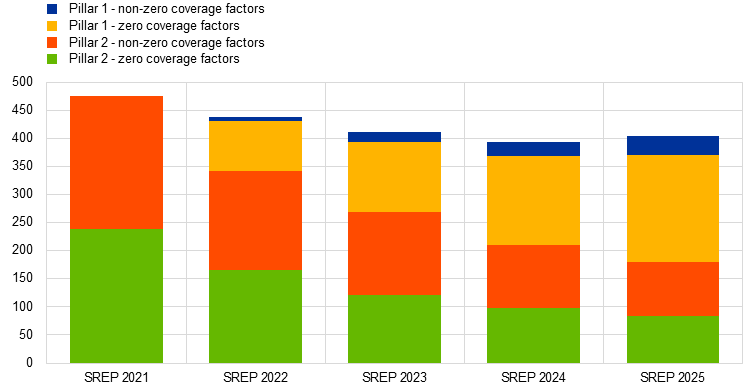
Chart 1
Non-performing exposure evolution and minimum coverage requirement over time
(EUR billions)
Source: ECB Banking Supervision.
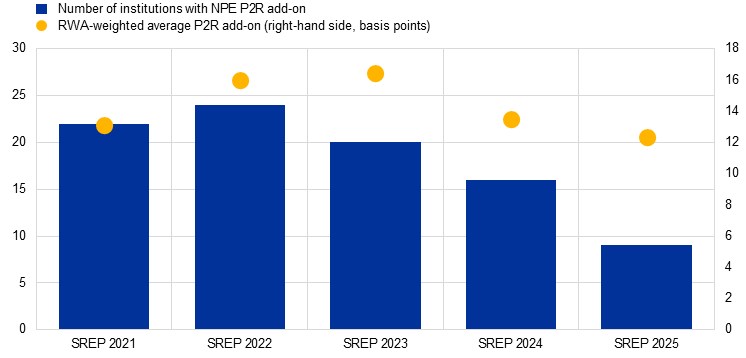
The volume of NPEs subject to loss coverage expectations dropped from nearly €500 billion in 2020 to around €180 billion at the end of 2024. Among other supervisory measures, since 2021 the ECB has been applying targeted, extra capital requirements (P2R add-ons) to banks that fail to set aside enough provisions. In the 2025 SREP cycle, only nine banks were subject to this specific add-on (the average value of the add-on, weighted by risk-weighted assets, was 12.4 basis points) – down from 22 banks when the policy was first introduced in 2021.
Chart 2
Shortfall from minimum coverage expectations and Pillar 2 add-ons
(total, basis points)
Source: ECB Banking Supervision.
These measures have contributed to keeping the average NPL ratio, excluding cash balances and central bank reserves, at around 2.2% over the last three years, which is a significant reduction compared with the previous decade (when the level was above 7%).
With much lower NPL levels, the ECB has decided to streamline its processes in line with the Next Level Supervision project while continuing to ensure that NPL levels stay at reasonable levels.
- Starting from 2026, the ECB’s NPE coverage expectations will no longer be communicated as an annual recommendation in SREP decisions. Instead, the ECB will issue a single operational act that sets NPE coverage expectations for several years.
- Banks with immaterial stocks of older NPEs which are within the scope of the ECB’s policies will no longer need to meet NPL coverage expectations or report on them – which should serve as an incentive to keep reducing NPLs.
- For certain NPEs, and if certain criteria are met, the ECB already allows banks to reduce the shortfall in relation to the minimum coverage expectations. Banks often rely on this possibility, submitting large volumes of requests reflecting bank-specific circumstances. To ensure that an excessive number of requests does not end up tricking the system, taking a risk-based approach the ECB will now increase its supervisory focus on those banks with more material requests. For the remaining banks, the level of scrutiny will stay unchanged.
These three concrete measures will streamline supervision processes while maintaining the NPL policy and its impact on banks with material volumes of NPLs.
The ECB’s experience shows that consistent and strong supervision works. Extending the ECB’s harmonised NPL approach to less significant institutions reflects this commitment, particularly as some smaller banks still carry sizable NPL portfolios. This will help ensure that all banks have suitable frameworks and resources to address any future rise in NPLs. Looking ahead, the ECB will also place greater emphasis on sound lending practices, as strong credit‑granting standards are essential to keeping NPL levels low over time.
Euroopan keskuspankki
Viestinnän pääosasto
- Sonnemannstrasse 20
- 60314 Frankfurt am Main, Germany
- +49 69 1344 7455
- media@ecb.europa.eu.
Kopiointi on sallittu, kunhan lähde mainitaan.
Yhteystiedot medialle