


- SUPERVISION NEWSLETTER
Understanding the EU banking sector’s capital framework
13 May 2026
Authors: Skirmantas Dzezulskis, Massimo Libertucci, Samuel McPhilemy
Capital adequacy requirements lie at the heart of prudential banking regulation. They require banks to fund a portion of their assets with their own money, instead of relying too much on debt for funding in the form of deposits and bonds. By requiring higher capital levels than banks would otherwise choose to hold, supervisors try to ensure that banks’ shareholders would be able to absorb any unexpected losses except in very unlikely scenarios, rather than passing them on to depositors or other creditors.
Regulation also protects financial stability by encouraging banks to take responsibility for the risks they create, including those affecting the financial system and the economy. It helps match banks’ interests with those of society, shaping how risks and rewards are shared among market participants, customers and the public.
International standards set by the Basel Committee on Banking Supervision form the basis of the capital framework in the EU. The international standards are implemented through regulation, supervision and macroprudential policy within a multi‑level institutional setting.
Recently some commentators and market participants have questioned whether EU rules go beyond the principles set by the Basel Committee on Banking Supervision, particularly through supervisors’ use of “super-equivalent” (i.e. stricter) regulations and additional discretions.[1] The ECB recently published a paper[2] describing the European capital framework and placing the EU’s specific choices in the context of the broader international framework.
Most EU capital requirements stem from the Basel standards. The standards include both prescriptive “Pillar 1” components, defined in the Basel texts, and elements that are deliberately left to supervisors to calibrate. Likewise, the EU framework combines harmonised regulatory requirements, generally derived from the prescriptive elements of the Basel standards, with supervisory and macroprudential measures tailored to bank‑specific risks and financial stability considerations in the EU and its Member States. These supervisory and macroprudential measures are calibrated by supervisors and macroprudential authorities, based on principles agreed at the Basel level.
The balance between fixed rules and flexible measures
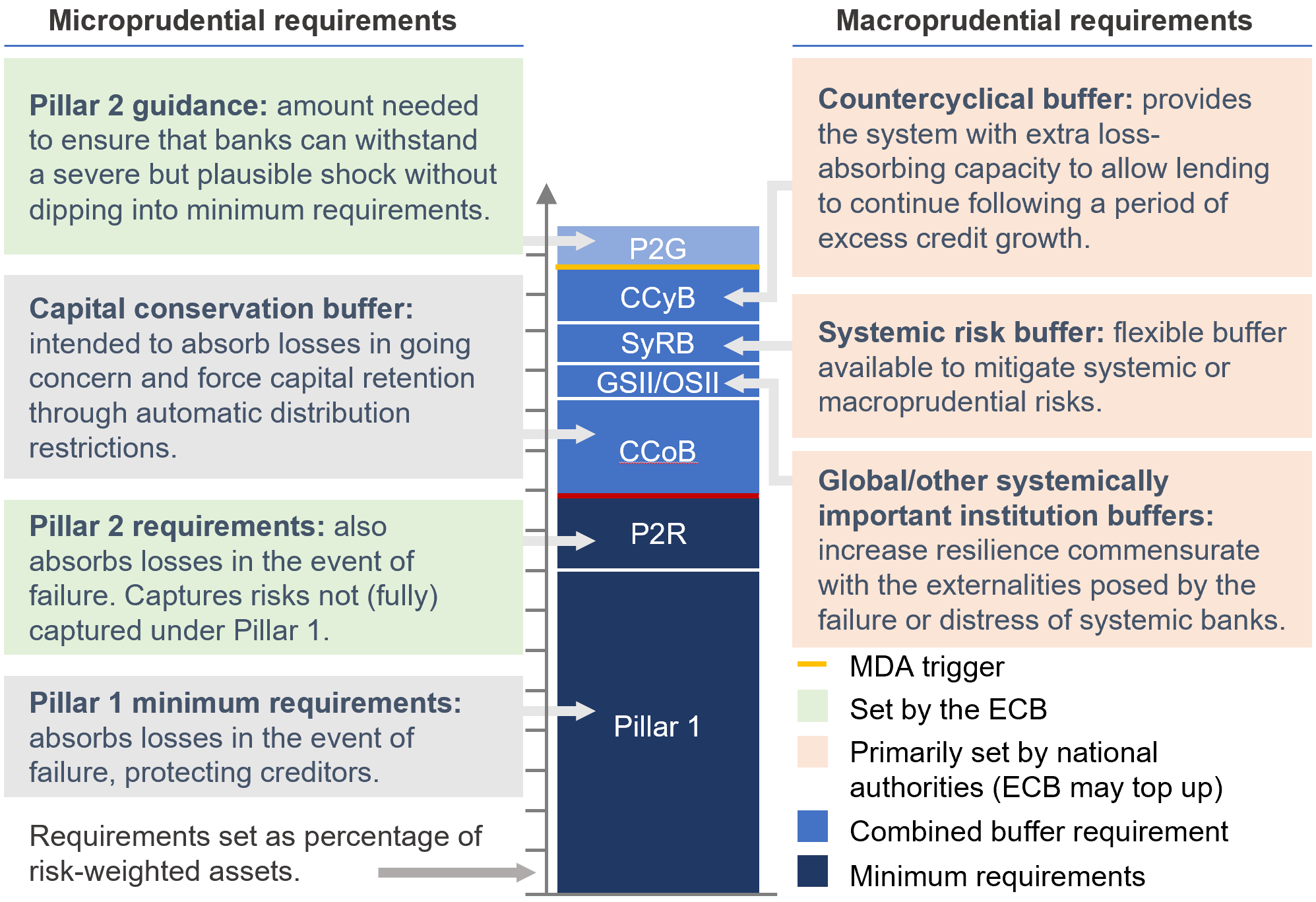
Rules derived from the prescriptive elements of the Basel standards account for around two-thirds of EU capital requirements. They include the definition and measurement of risk‑weighted assets, the minimum capital ratios under Pillar 1, the capital conservation buffer and the global systemically important institution (G‑SII) buffer. These elements are largely fixed in legislation and apply in a harmonised way across the EU.
Around one-third of capital requirements come from non‑prescriptive (“principles-based”) Basel elements that are implemented and calibrated at EU or national level. This includes microprudential measures set by the ECB, such as the Pillar 2 requirement which captures risks not fully covered under Pillar 1, and the Pillar 2 guidance which is designed to cover potential stress scenarios and emerging risks that may not yet be fully quantifiable or apparent. It also includes macroprudential measures, such as the countercyclical capital buffer and buffers for other systemically important institutions (O-SIIs). Macroprudential measures remain largely decentralised: they are set by national macroprudential authorities, with a limited role for the ECB in “topping-up” requirements where necessary.
Together, these elements ensure that material risks identified in the Basel framework are adequately covered and that banks can withstand severe but plausible stress. There is, however, a recognised need for greater consistency and harmonisation in how prudential and macroprudential tools are applied across the EU, as also highlighted in the report issued by the ECB Governing Council’s High-Level Task Force on Simplification.
Figure 1
The risk-based capital stack applicable to significant institutions
Source: Dzezulskis, Libertucci and McPhilemy (2026).
Note: MDA stands for maximum distributable amount.
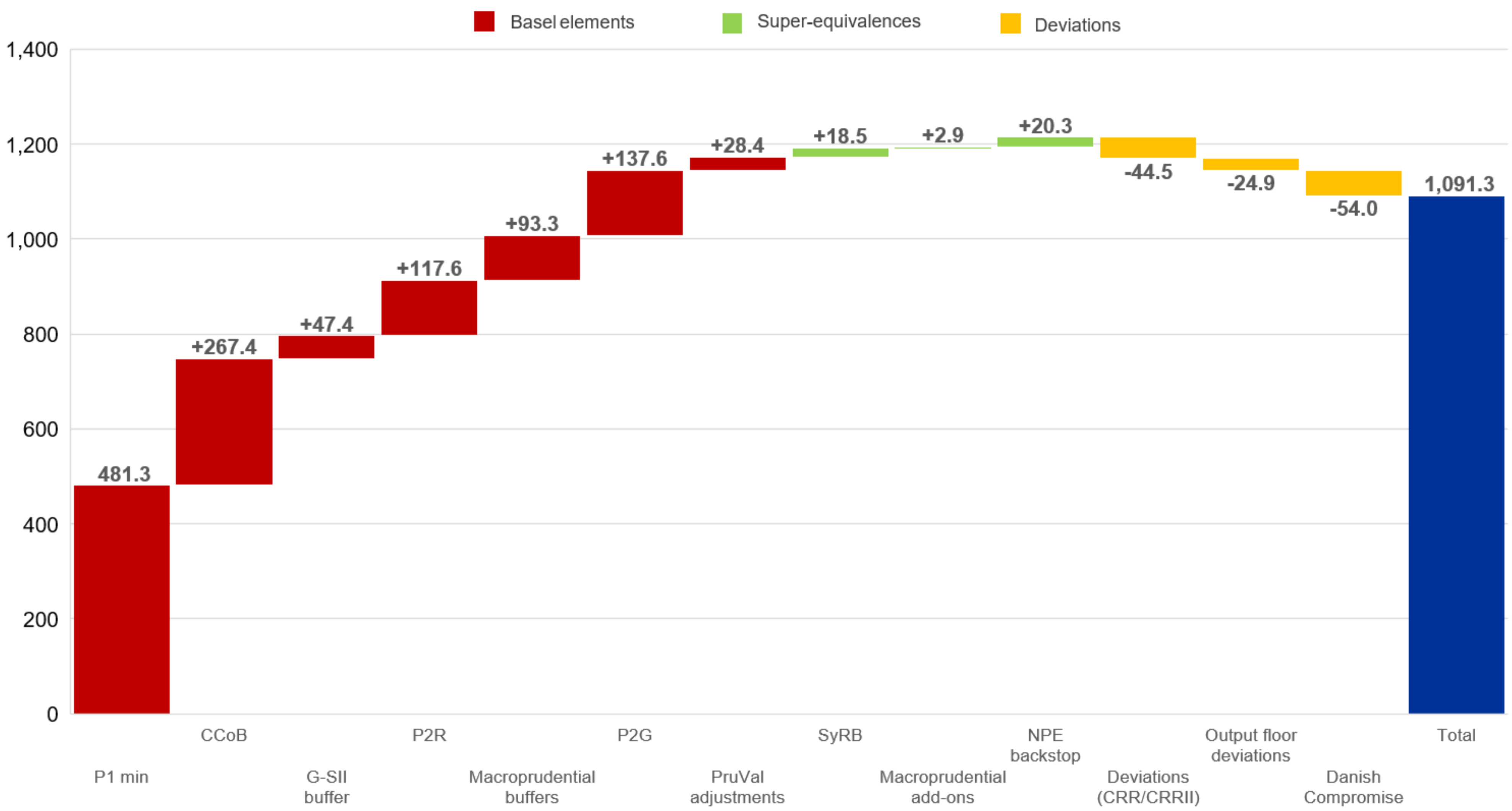
The EU framework only includes a limited number of measures that are stricter than – or not based on – the Basel standards. These are known as “super‑equivalences” and include the Systemic Risk Buffer and the prudential backstop for non‑performing exposures. Such measures are consistent with the Basel framework, which sets minimum standards that jurisdictions may exceed when risks warrant it. The capital requirements stemming from super-equivalences make up around €41 billion, which is only 4% of the total requirements (see Figure 2).
At the same time, the EU framework contains several deviations that are less strict than the Basel framework. These mainly affect the calculation of risk‑weighted assets or the treatment of specific exposures. Examples include the supporting factor (a measure that lowers requirements) for exposures to small and medium‑sized enterprises, exemptions in the credit valuation adjustment framework and the Danish Compromise for bancassurance groups. In addition, EU legislation includes some temporary deviations relating to the Basel III output floor, which is a regulatory safeguard against the possible misestimation of risk through the use of banks’ internal models. These transitional arrangements are intended to (i) give banks additional time to adjust to the full phase-in of the Basel III reforms and (ii) to support market developments, such as expanding the availability of external credit ratings to assess the riskiness of certain assets instead of relying on internal models. In general, deviations reflect specific features of the EU economy and financial system. In aggregate, they lower overall requirements at the system-wide level by around 10%.
Figure 2
European specificities – impact on CET1 minimum required capital in 2030
(EUR billions)
Source: Dzezulskis, Libertucci and McPhilemy (2026).
Notes: The reference period is the second quarter of 2025. “PruVal adjustments” refers to CET1 adjustments for prudential valuation. “Macroprudential add-ons” refers to risk-weight measures under Articles 458 and 459 of the Capital Requirements Regulation (CRR). “NPE backstop” refers to the non-performing exposures backstop under Pillars 1 and 2. “Deviations (CRR/CRR II)” refers to the supporting factor for exposures to small and medium-sized enterprises, the infrastructure supporting factor and credit valuation adjustment exemptions. “Output floor deviations” refers to the transitional deviations related to the output floor, which are set to expire at the end of 2032, including the treatment of exposures to unrated corporations, the preferential treatment of exposures to residential real estate and the lower calibration of the standardised approach for exposures to securitisation. “Danish Compromise” refers to reduced capital requirements for holdings in insurance undertakings pursuant to Article 49(1) of the CRR.
The cumulative picture does not support claims that EU capital requirements systematically exceed the Basel standards. While EU requirements are higher than the purely prescriptive Basel elements, this mainly reflects the implementation of other, non‑prescriptive, parts of the Basel framework including the use of macroprudential tools.
Evolution of capital adequacy and requirements
After the global financial crisis, risk-based capital requirements and capital adequacy ratios in the EU increased significantly. Risk-based capital ratios rose strongly during the 2010s as banks deleveraged and the first phase of Basel III reforms – including a stricter definition of regulatory capital and requirements to maintain additional capital buffers – was introduced. At the same time, the aggregate risk-weight density of euro area banks – a measure of the overall riskiness of their assets – declined somewhat. In non-risk-based terms, capital adequacy increased more modestly, with average leverage ratios rising from around 5% in 2015 to just under 6% in 2025.
During the COVID‑19 pandemic, authorities temporarily reduced capital requirements by releasing buffers and adjusting the composition of supervisory capital requirements. This was done because the situation was highly uncertain and there was an expectation that the crisis could result in significant losses for banks. The idea was to help banks keep on lending even if things got worse, instead of forcing them to stop lending to protect their capital positions. In the end, government spending and central bank actions cushioned the impact of the crisis on households and firms, so banks mostly avoided losses and did not need to use these buffers after all.
After the pandemic, macroprudential authorities gradually reinstated and increased releasable buffers, in particular the countercyclical capital buffer. As a result, the composition of capital requirements has shifted towards buffers that can be released if economic downturns lead to losses and threaten to impair banks’ ability to lend.
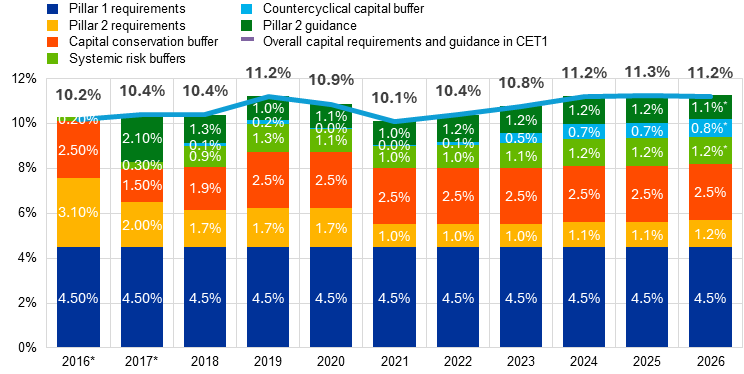
Figure 3
Developments in overall CET1 requirements and Pillar 2 guidance among significant institutions
(percentages of risk-weighted assets)
Source: Dzezulskis, Libertucci and McPhilemy (2026).
Notes: The data refer to the requirements applicable as of the fourth quarter of each year. For 2026, buffers are estimated based on announced rates currently applicable; estimated values are marked with an asterisk. The sample includes all significant institutions (with a changing composition). “Overall capital requirements and guidance in CET1” refers to the minimum CET1 requirements under Pillar 1 and the Pillar 2 requirement, the capital conservation buffer, systemic buffers (G-SII, O-SII and SyRB), the CCyB and Pillar 2 guidance. Rounding differences may apply. The chart shows RWA-weighted data. However, due to data constraints for 2016 and 2017 (indicated by an asterisk) the values are simple averages rather than weighted averages. In the 2015 Supervisory Review and Evaluation Process (SREP), in which the ECB determined the requirements applicable in 2016, the ECB frontloaded the imposition of the capital conservation buffer, which was otherwise scheduled to be phased in under the CRR between 2016 and 2019. In the 2016 SREP, the ECB revised its requirements to allow for the introduction of Pillar 2 guidance.
These increases, however, have not significantly impeded banks from granting new loans. Recent ECB research shows that macroprudential capital buffer increases since the pandemic have only had a modest impact on aggregate credit supply, as banks have benefited from sufficient capital headroom to be able to absorb the higher requirements without cutting back on lending.[3]
As at 2026, the aggregate required Common Equity Tier 1 (CET1) ratio of significant institutions stands at around 11.2%, which is close to the pre‑pandemic level observed in 2019. Recent regulatory changes, including the implementation of the final Basel III reforms, have had only a limited impact on requirements in the short term. Transitional arrangements will smooth the effects until full phase‑in, which is expected to be completed by 2032. Banks have generally been able to meet the higher requirements without difficulty, reflecting strong capital positions built up over time.
International comparison
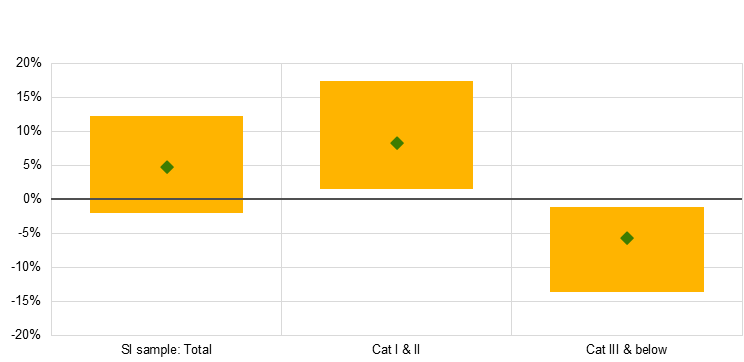
The question of how EU requirements stack up against those of peer jurisdictions – most notably the United States – has been a focal point of debate. A number of recent studies find the EU capital requirements to be broadly comparable to those in other major jurisdictions.[4] However, simply comparing the average capital ratios of banks in different countries can be misleading, given differences in banking structures and regulatory frameworks. An alternative approach involves asking how banks’ capital requirements would change if they were subject to the requirements of another jurisdiction. When key elements of the US prudential framework are applied hypothetically to EU banks, the results show that requirements would be somewhat higher on average.
Figure 4
Minimum required capital under a counterfactual US framework versus the actual EU framework, by category of significant institutions
(percentages)
|
Source: Dzezulskis, Libertucci and McPhilemy (2026).
Notes: "SI sample: Total" refers to the total sample of significant institutions (SIs). "Cat I & II" refers to SIs in Categories I and II, while "Cat III & below" refers to those in Categories III, IV and Other.
The difference is greatest for the largest, globally active banks, mainly owing to the stricter buffers for global systemically important banks and to the US “Collins floor”, which limits the benefits that US banks can derive from using internal models to risk-weight their assets. By contrast, mid‑sized EU banks would face lower requirements under the US framework, reflecting the absence of certain supervisory add-ons and macroprudential buffers in the US framework. This alternative approach is informative but presents limitations which are intrinsic to the methodology and are thoroughly described in Dzezulskis, Libertucci and McPhilemy (2026).
This counterfactual analysis is one way to compare capital requirements across jurisdictions. In reality, of course, many other factors matter. Every jurisdiction adapts requirements to the specifics of the local banking sector. In turn, banks optimise their businesses to reduce regulatory costs. It is therefore unsurprising that hypothetically applying the rules of one jurisdiction to the banks of another can yield some outsized differences between actual and notional requirements.
Despite the limitations mentioned above, the results support the conclusion that EU capital requirements do not place large internationally active EU banks at a significant competitive disadvantage compared with their international peers.
Building stronger banks: the impact of capital on lending and performance
A robust capital framework is essential not only for enhancing the resilience of banks, but also for supporting consistent lending activity across economic cycles. Evidence demonstrates that banks with stronger capital positions are able to maintain steadier lending volumes, even during periods of economic stress, thereby underpinning financial stability and supporting the economy.[5] Rather than acting as a brake on lending, the capital framework ensures that institutions are well capitalised and therefore better equipped to absorb shocks and continue providing credit when it is most needed. On the other hand, lowering capital requirements would risk undermining the resilience of both individual institutions and the broader banking sector, potentially amplifying volatility in lending during downturns.
There is a large body of research on the impact of higher capital requirements on lending.[6] While the results differ across studies, evidence generally shows that when profitability and capital positions are strong, banks tend to meet a significant share of higher requirements through retaining earnings and reduced capital headroom, rather than by materially deleveraging.[7] Lending growth was subdued during the post-crisis decade. However, many factors influence credit supply and the influence of capital requirements on lending cannot be inferred solely from the aggregate trend. Importantly, the rapid expansion of lending before the crisis proved to be unsustainable and led to a period of deleveraging. The pre-crisis period should not, therefore, be considered a benchmark for an appropriate long-term trend.
From a public policy perspective, indicators of bank profitability also need careful interpretation. Pre‑crisis returns reflected unsustainable risk‑taking and are not a suitable benchmark. Lower leverage and adjusted risk‑return profiles are intended outcomes of post‑crisis reforms. At the same time, recent experience has shown that stronger capital positions are compatible with improved profitability.
In summary, maintaining robust capital requirements remains critical for ensuring that banks can lend reliably across cycles, without compromising profitability or investor confidence. The evidence supports a prudent approach that resists calls for reduced capital standards, recognising that strong capital positions benefit both banks and the wider economy in the long run.
See Mejino-López, J. and Véron, N. (2025), “EU banking sector & competitiveness – Framing the policy debate”, In-Depth Analysis, European Parliament, Brussels, May.
See Dzezulskis, S., Libertucci, M. and McPhilemy, S. (2026), “Understanding the banking sector capital framework in the European Union”, Occasional Paper Series, No 387, ECB, Frankfurt am Main, April
See Behn et al. (2024), “Buying insurance at low economic cost – the effects of bank capital buffer increases since the pandemic”, Working Paper Series, No 2951, ECB, Frankfurt am Main, July. For broader evaluations of the impacts of post-crisis reforms, see Basel Committee on Banking Supervision (2022), “Evaluation of the impact and efficacy of the Basel III reforms”, 14 December; and Financial Stability Board (2021), “Evaluation of the Effects of Too-Big-To-Fail Reforms Final Report”, 1 April.
See Berg, J., Boivin, N. and Geeroms, H. (2025), “The quickly fading memory of why and when bank capital is important”, Working Paper, Issue no 04/2025, Bruegel; Mejino-López, J. and Véron, N. (2025); Resti, A. (2025), “How have European banks developed along different dimensions of international competitiveness?”, In-Depth Analysis, European Parliament, Brussels, April; Restoy, F. (2025), “Financial regulation and growth: what should be the European policy priorities?”, speech at the FinSAC conference entitled “Financial sector stability in times of geopolitical turbulence”, Vienna, 27 May.
See Gambacorta, L. and H.S. Shin (2018), “Why bank capital matters for monetary policy”, Journal of Financial Intermediation, Vol. 35, part B.
See the Financial Regulation Assessment: Meta Exercise (FRAME) on the Bank for International Settlements’ website. This is a repository of studies on the effects of capital and liquidity regulation as well as the too-big-to-fail reforms. See also Malovaná, S. et al. (2024), “Bank capital, lending, and regulation: A meta-analysis”, Journal of Economic Surveys, Vol. 38, Issue 3.
See Behn, M. (2024); Couaillier, C. (2021), “What are banks’ actual capital targets?”, Working Paper Series, No 2618, ECB, December; and Lang, J. and Menno, D. (2025), “The state-dependent impact of changes in bank capital requirements”, Working Paper Series, No 2828, ECB;
Euroopan keskuspankki
Viestinnän pääosasto
- Sonnemannstrasse 20
- 60314 Frankfurt am Main, Germany
- +49 69 1344 7455
- media@ecb.europa.eu.
Kopiointi on sallittu, kunhan lähde mainitaan.
Yhteystiedot medialle