


- SUPERVISION NEWSLETTER
Reassessing bank board suitability when new relevant facts emerge
Authors: Donatas Janulaitis, Maria Michalik, Elizaveta Klippert
Banks operate under changing circumstances, and so do their boards. Board members and key function holders (“key individuals”) must meet suitability standards (also known as “fit and proper” requirements) at the time of appointment and throughout their tenure. The ECB and national supervisors oversee compliance with these standards and provide a structured process for banks to address and report any relevant changes affecting suitability.
Relevant new facts
When banks become aware of relevant new facts that could affect a key individual’s suitability, they must assess the impact and inform the supervisor as soon as possible. Relevant new facts include concerns about professional conduct or reputation, changes in role, legal proceedings, regulatory action, conflicts of interest and new professional or business relationships. A relevant fact may also concern the bank itself. For example, an acquisition may make a bank larger and more complex, so that its board members have to commit more time to their duties.
Banks must promptly assess how a new fact affects a key individual’s suitability and should act before the competent authority reaches a decision. For example, a bank may ask the individual to abstain from voting if a new conflict of interest could affect their independence of mind. In most reassessment cases, banks address the concerns themselves, and no new ECB decision is needed.
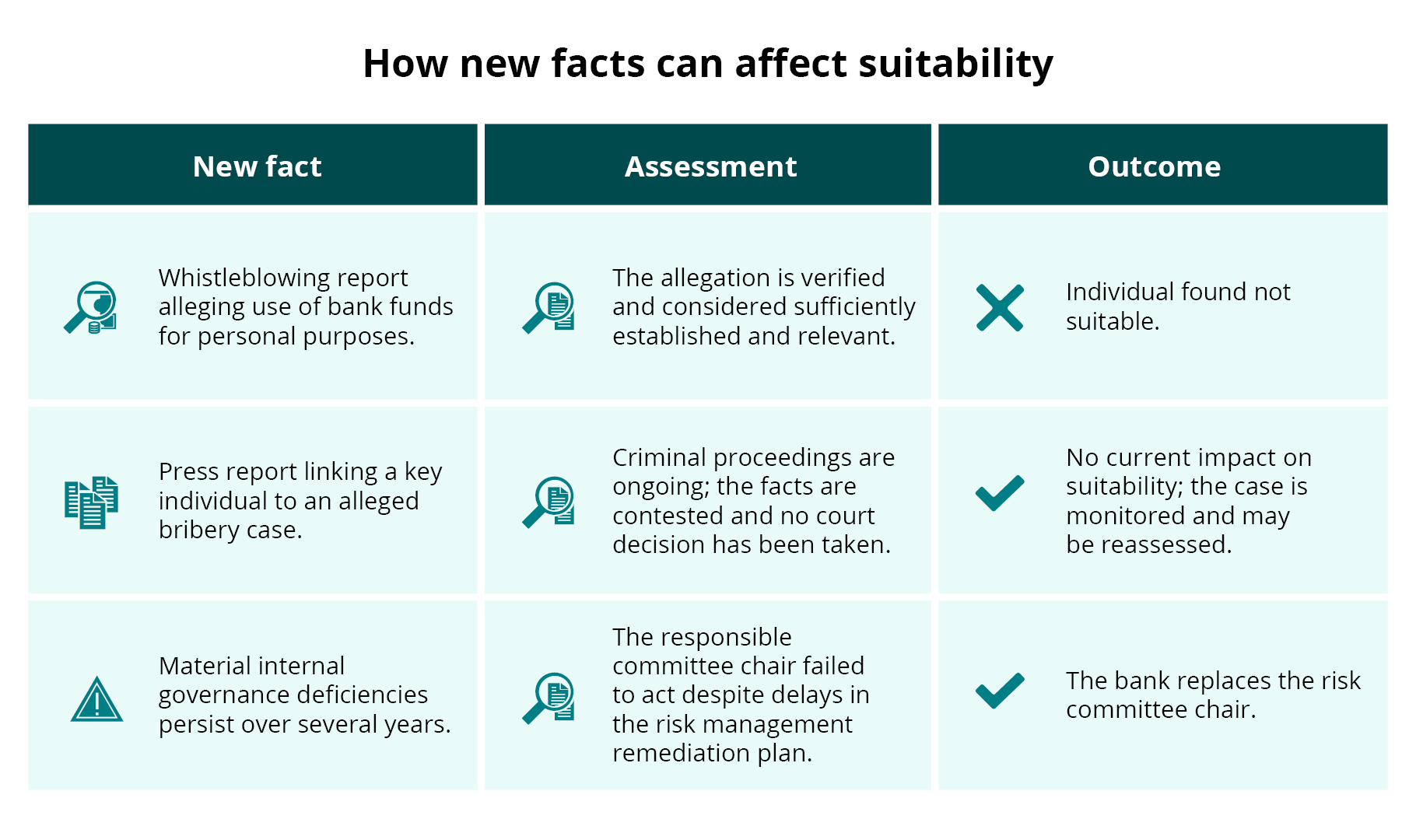
The ECB or national supervisor will reassess suitability when they receive new, sufficiently established and relevant information that could change the earlier assessment. A reassessment does not automatically lead to a negative decision: it may confirm suitability or identify issues that need to be addressed.
Keeping supervisors informed
Banks must report a relevant new fact to the relevant national supervisor, which in turn notifies the ECB thereof, without delay and provide supporting documents when available. Unless the relevant new fact is time sensitive, the notification should include the bank’s assessment of how the fact affects the suitability of the key individuals.
As of 31 July 2026 banks should notify material new facts through the SSM Portal. If banks are required by national law to inform their supervisory authority of the relevant new facts through a specific channel, they should continue to follow the national requirements, unless the national supervisor instructs them otherwise.
Over time, the ECB aims to integrate national systems into the SSM Portal so it becomes a single notification gateway for supervised banks.
After receiving information about new facts, the ECB first checks whether the facts are indeed new, sufficiently established and relevant to suitability. In the event they could affect a key individual’s suitability, the ECB starts a reassessment.
The ECB can then collect further information and ask the bank to conduct a self-assessment if it has not already done so. It evaluates the materiality of the new facts and the extent to which they affect the individual’s suitability.
Depending on the outcome, the ECB can close the case without a new fit and proper decision or issue a decision with conditions or obligations to address remaining concerns. In severe cases, it can conclude that the individual is no longer suitable for the position.
New facts can shape banking governance, which is why assessing suitability is not a one-off process. Identifying, assessing and notifying relevant new facts in good time allows banks and supervisors to respond when circumstances change. This in turn helps ensure that banks are at all times managed and overseen by individuals who meet the expected standards.
Ευρωπαϊκή Κεντρική Τράπεζα
Γενική Διεύθυνση Επικοινωνίας
- Sonnemannstrasse 20
- 60314 Frankfurt am Main, Germany
- +49 69 1344 7455
- media@ecb.europa.eu
Η αναπαραγωγή επιτρέπεται εφόσον γίνεται αναφορά στην πηγή.
Εκπρόσωποι Τύπου